 LumeAPI
Last verified: July 25, 2026
Claude Opus 5 and GPT-5.6 Sol are close enough in general intelligence that the right choice depends on the work. Opus 5 is stronger on complete analytical deliverables, business automation, computer use, multimodal repository tasks, and flat-price long context. GPT-5.6 Sol is the better starting point for DeepSWE-style coding, terminal-heavy agents, presentation finish, higher output speed, and teams already using OpenAI's Responses API tools. For LumeAPI users today, Sol also has a decisive practical advantage: it is listed in the live catalog at 70% below its official reference rates, while Opus 5 is not yet listed.
Executive Summary
- Use Opus 5 for difficult knowledge work and cross-application agents. It leads Sol on GDPval-AA v2, AA-Briefcase overall Elo, AutomationBench, OSWorld, SWE-bench Pro, and multimodal coding.
- Use GPT-5.6 Sol for terminal coding and polished presentations. Sol leads DeepSWE and has the highest presentation Elo in AA-Briefcase.
- Official token prices are close, but long-context rules differ. Opus is $5/$25 per million input/output tokens with flat pricing through 1M context. Sol is $5/$30 and charges elevated rates when input exceeds 272k tokens.
- Current LumeAPI availability changes the near-term decision. Sol is listed at $1.50/$9 per MTok; Opus 5 was absent from the catalog on July 25.
Specifications that affect architecture
| Dimension | Claude Opus 5 | GPT-5.6 Sol |
|---|---|---|
| Model ID | claude-opus-5 | gpt-5.6-sol or gpt-5.6 alias |
| Context | 1M | 1.05M |
| Maximum output | 128k | 128k |
| Knowledge cutoff | May 2026 reliable cutoff | February 16, 2026 |
| Official input / output | $5 / $25 per MTok | $5 / $30 per MTok |
| Cached input | $0.50 per MTok | $0.50 per MTok |
| Long-context pricing | Standard rate through 1M | Above 272k input: 2× input and 1.5× output |
| Reasoning effort | low, medium, high, xhigh, max | none, low, medium, high, xhigh, max |
| First-party tool surface | Claude tools and betas | Responses API hosted tools |
The nominal context windows look equivalent, but the billing curves are not. A request with 300,000 input tokens and 20,000 output tokens costs about $2.00 on Opus at list price. Under OpenAI's documented long-context multiplier, the comparable Sol request costs about $3.90 before tool fees. Retrieval and caching may still be better than sending either model hundreds of thousands of tokens, but Opus has the simpler price curve.
Sources: Claude model overview, OpenAI GPT-5.6 Sol model page, and OpenAI model guidance.
General intelligence is a near-tie
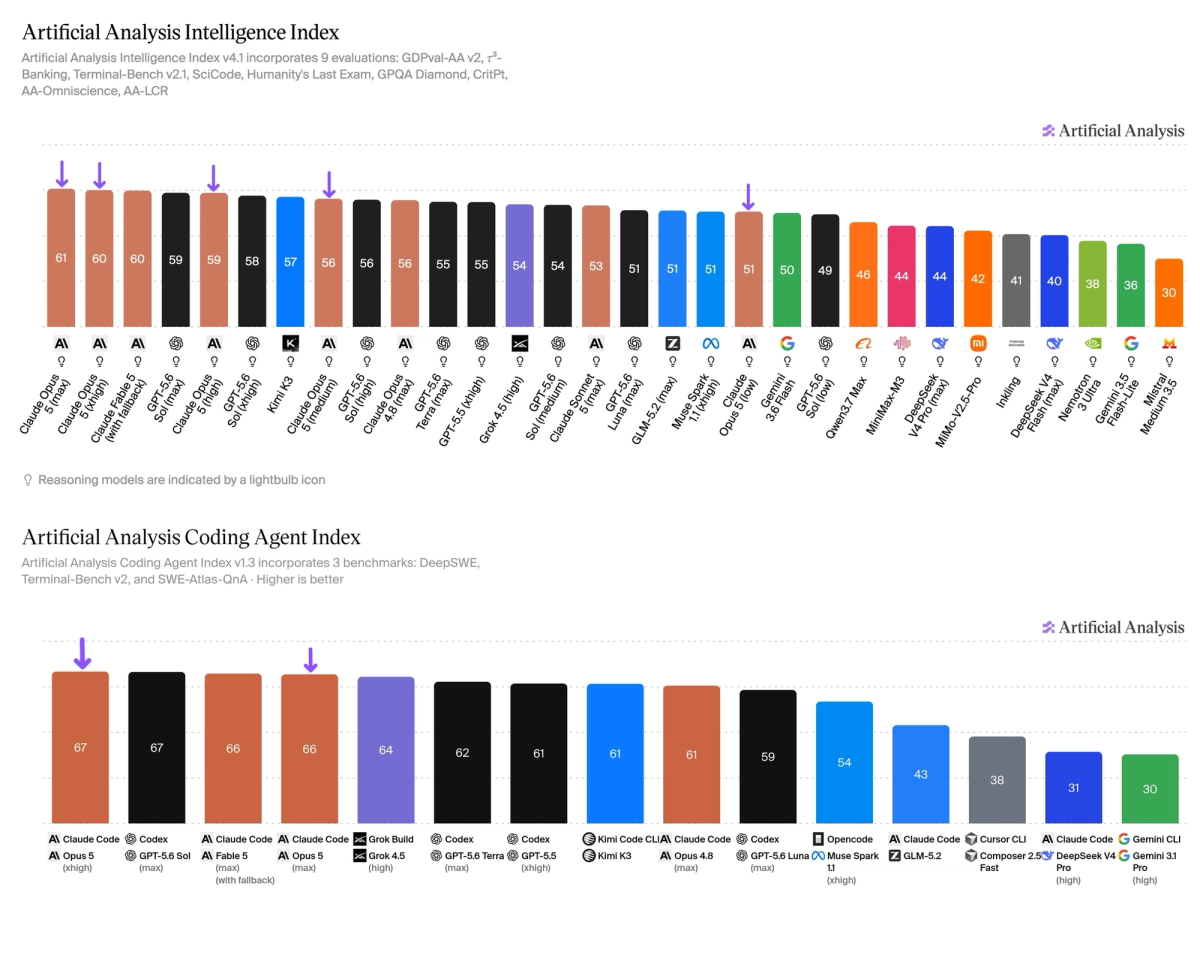
Figure 1. Artificial Analysis Intelligence Index v4.1 and Coding Agent Index v1.3. Source: Artificial Analysis. Agent harnesses and effort settings are part of the tested system.
Opus 5 max scores 61 and GPT-5.6 Sol max scores 59 on the Intelligence Index. A two-point lead supports putting Opus in the same or slightly higher frontier tier, but not declaring it universally superior. The index combines nine evaluations with different task populations; a product should route based on the subtask it resembles.
Artificial Analysis measured about 52.8 output tokens per second for Opus max. Sol xhigh was measured around 70.2 tokens per second. Those settings are not perfectly matched, but they support a practical observation: Sol is often the better interactive candidate, while Opus's strongest results can require more time and output.
Coding: Sol leads one important benchmark, Opus leads several others
Anthropic's system-card comparison reports:
| Coding evaluation | Opus 5 | GPT-5.6 Sol | Interpretation |
|---|---|---|---|
| SWE-bench Pro | 79.2 | 64.6 | Opus advantage on repository issue resolution |
| DeepSWE v1.1 | 68.8 | 72.7 | Sol leads terminal-heavy software engineering |
| FrontierCode main | 53.4 | 47.5 | Opus leads; its best setting was medium |
| Frontier-Bench | 43.3 | 34.4 | Opus leads agentic coding tasks |
| Coding Agent Index | 67 at Opus xhigh | 67 at Sol max | Current composite tie |
The correct takeaway is not that one benchmark is right and the others are wrong. DeepSWE, FrontierCode, and SWE-bench use different tasks and scaffolds. Claude Code and Codex are also part of the measured systems. A raw API completion will not reproduce an agent-harness score without the same tools, context management, retry logic, and patch validation.
Start with Sol for terminal-driven implementation where the agent repeatedly runs commands, tests, and patches. Start with Opus for cross-file reasoning, screenshot-based issues, repository research, or tasks that mix code with a substantial written artifact. For tightly scoped pull requests, test Opus at medium: Anthropic found that higher effort could over-refactor FrontierCode tasks.
Token efficiency is a Sol advantage
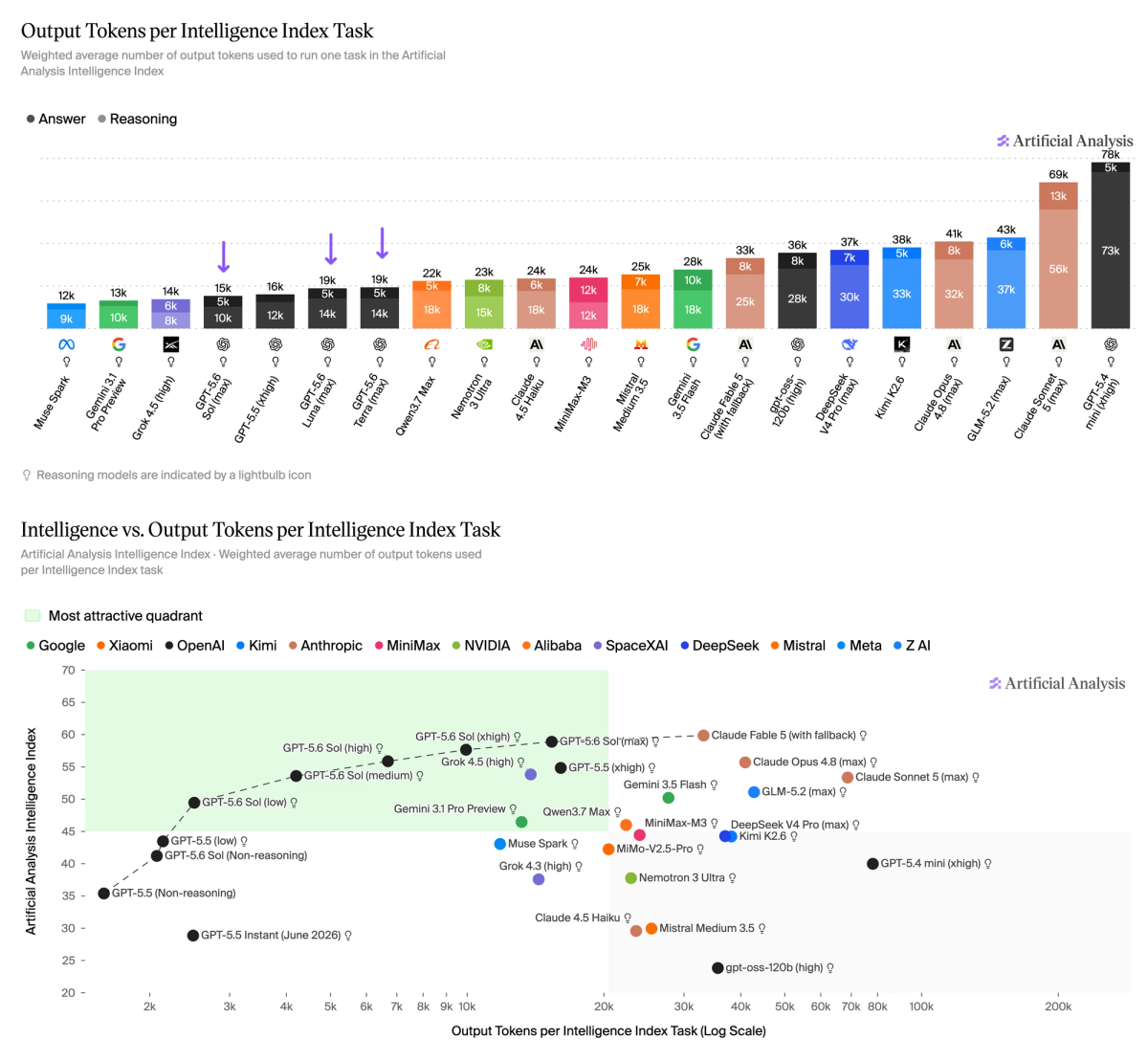
Figure 2. Output-token use and intelligence versus output tokens when GPT-5.6 launched on July 9, before Opus 5 was added. Source: Artificial Analysis GPT-5.6 evaluation. Use it to understand Sol's effort curve, not as the current overall ranking.
Sol's main economic advantage is not only its price. Artificial Analysis reported roughly 15,000 output tokens per Intelligence Index task at max when GPT-5.6 launched, much lower than comparable Claude models at the time. Opus 5 can also become efficient at high or xhigh, but max remains slower and verbose. Measure total output, reasoning, tool calls, retries, and accepted-task rate rather than comparing only published MTok prices.
Professional deliverables favor Opus, except presentation finish
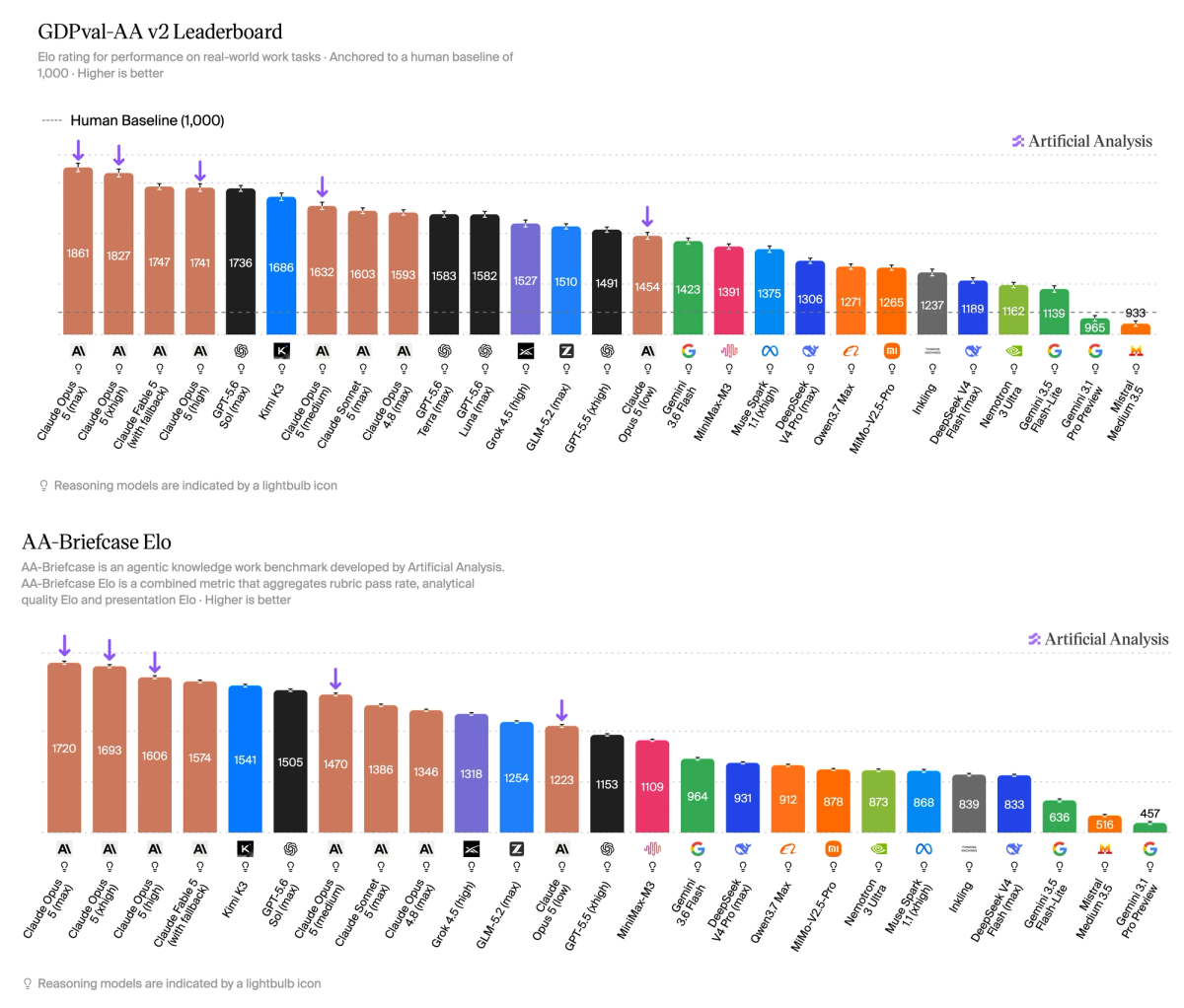
Figure 3. GDPval-AA v2 and AA-Briefcase Elo ratings after the Opus 5 release. Source: Artificial Analysis.
Opus 5 max scores 1861 on GDPval-AA v2 and 1720 on AA-Briefcase. Sol scores roughly 1735 and 1503. Opus's advantage is strongest in rubric completion and analytical quality across long, multi-file projects.
Sol has a meaningful counter-signal: its AA-Briefcase presentation Elo is about 1666, versus 1628 for Opus. If the deliverable is a slide deck, polished spreadsheet, or frontend whose visual finish matters as much as analytical completeness, Sol deserves a direct trial. A strong workflow can also route analysis to Opus and a final presentation pass to Sol.
Automation and computer use favor Opus
Zapier AutomationBench reports Opus 5 max at 26.2% and Sol max at 18.1%. Anthropic reports OSWorld 2.0 scores of 70.6 for Opus and 62.6 for Sol. BrowseComp is essentially tied at 90.8 versus 90.4.
These results suggest Opus for browser agents, cross-app workflows, and research that mixes search with stateful actions. They do not support unsupervised execution: a 26.2% strict success rate still implies many failures. Use deterministic state assertions, tool allowlists, approval gates, and idempotent operations.
API and tool ecosystem differences
GPT-5.6 Sol supports OpenAI's Responses API with web search, file search, code interpreter, hosted shell, apply patch, computer use, MCP, skills, and tool search. Opus 5 adds mid-conversation tool changes, server-side fallback, and fast mode through Anthropic beta or preview interfaces. Provider-specific features are not automatically portable through an OpenAI-compatible gateway.
Choose the tool surface before assuming model quality transfers. If your application depends on a hosted OpenAI tool, test Sol directly or verify gateway support. If you control the tools yourself, a shared OpenAI-compatible client can make task-level A/B testing much easier.
Current LumeAPI economics
The LumeAPI GPT-5.6 Sol page listed Sol at $1.50 input and $9 output per million tokens on July 25, 70% below the official $5/$30 reference. Opus 5 was not in the catalog.
For one million input and 200,000 output tokens:
- Official Opus 5: $10
- Official GPT-5.6 Sol: $11
- Current LumeAPI GPT-5.6 Sol catalog rate: $3.30
This is a dated catalog comparison, not a promise that every OpenAI feature, context length, or hosted tool is exposed through the gateway. Confirm the model page and test the exact request shape. LumeAPI's usage logs can then track model, tokens, latency, and request cost; your application should add task outcome so you can calculate cost per accepted result.
Scenario decision
| Workload | Start with | Challenger |
|---|---|---|
| Terminal-heavy coding agent | GPT-5.6 Sol max/xhigh | Opus high |
| Repository research and multimodal issue | Opus high | Sol max |
| Long analytical report or spreadsheet | Opus high/xhigh | Sol for presentation pass |
| Presentation or visually polished frontend | GPT-5.6 Sol | Opus for analysis |
| Browser and cross-app automation | Opus medium/high | Sol with deterministic checks |
| More than 272k prompt tokens | Opus with retrieval/cache | Sol only after multiplier analysis |
| Current discounted gateway use | GPT-5.6 Sol on LumeAPI | Listed Claude alternatives |
Final recommendation
Do not select between Opus 5 and GPT-5.6 Sol using one global leaderboard. Use Opus as the first candidate for complete knowledge work, computer use, and multi-step business workflows. Use Sol for DeepSWE-like coding, faster interactive output, and presentation-heavy deliverables. If you are deploying through LumeAPI today, Sol's verified availability and current catalog discount make it the actionable route, while Opus remains a direct-provider or future-catalog evaluation target.