 LumeAPI
Last verified: July 25, 2026
Claude Opus 5 is the stronger choice for the hardest coding, professional knowledge work, computer use, and long-horizon agents. Grok 4.5 is the more economical engineering model: its official $2/$6 token price, relatively concise output, Grok Build harness, and strong coding-agent results make it attractive when cost per completed task matters more than winning the highest overall benchmark. Grok also offers first-party real-time web and X search in its product ecosystem, while Opus provides twice the context window and a higher capability ceiling.
Neither Opus 5 nor Grok 4.5 appeared in the LumeAPI text-model catalog on July 25. Grok 4.3 and Grok media models were listed, but that does not imply Grok 4.5 compatibility.
Executive Summary
- Choose Opus 5 for the hardest work. It scores 61 versus Grok's 54 on the Artificial Analysis Intelligence Index and leads current AA-Briefcase by more than 400 Elo.
- Choose Grok 4.5 for coding-agent economics. SpaceXAI charges $2/$6 per MTok; independent evaluation previously placed Grok Build near the leading coding agents at a fraction of Fable and GPT task cost.
- Context is an Opus advantage. Opus supports 1M tokens at flat standard rates. Grok supports 500k and applies higher pricing once prompts cross 200k.
- Reliability needs retrieval and verification. Artificial Analysis found Grok's factual accuracy improved while hallucination also rose sharply.
Specifications and price
| Dimension | Claude Opus 5 | Grok 4.5 |
|---|---|---|
| Model ID | claude-opus-5 | grok-4.5 |
| Context | 1M | 500k |
| Standard input / output | $5 / $25 per MTok | $2 / $6 per MTok |
| Cache hit | $0.50 | $0.50 |
| Long-context threshold | No separate tier through 1M | At 200k; documented long rate $4/$12 |
| AA output speed | About 52.8 t/s at max | About 67.1 t/s at high |
| Input / output modality | Text and image in; text out | Text and image in; text out |
| Main first-party agent | Claude Code | Grok Build |
For one million input tokens and 200,000 output tokens, Opus costs $10. Grok's standard-rate arithmetic would be $3.20, but a one-million-token request is impossible because its context is 500k. At 250,000 input and 50,000 output tokens, SpaceXAI's long-context tier applies to the whole request, producing approximately $1.60, versus $2.50 on Opus. Grok remains cheaper, but the discount is smaller than the headline rate suggests.
Sources: SpaceXAI Grok 4.5 launch, SpaceXAI pricing documentation, and Claude model overview.
Opus has the higher quality ceiling
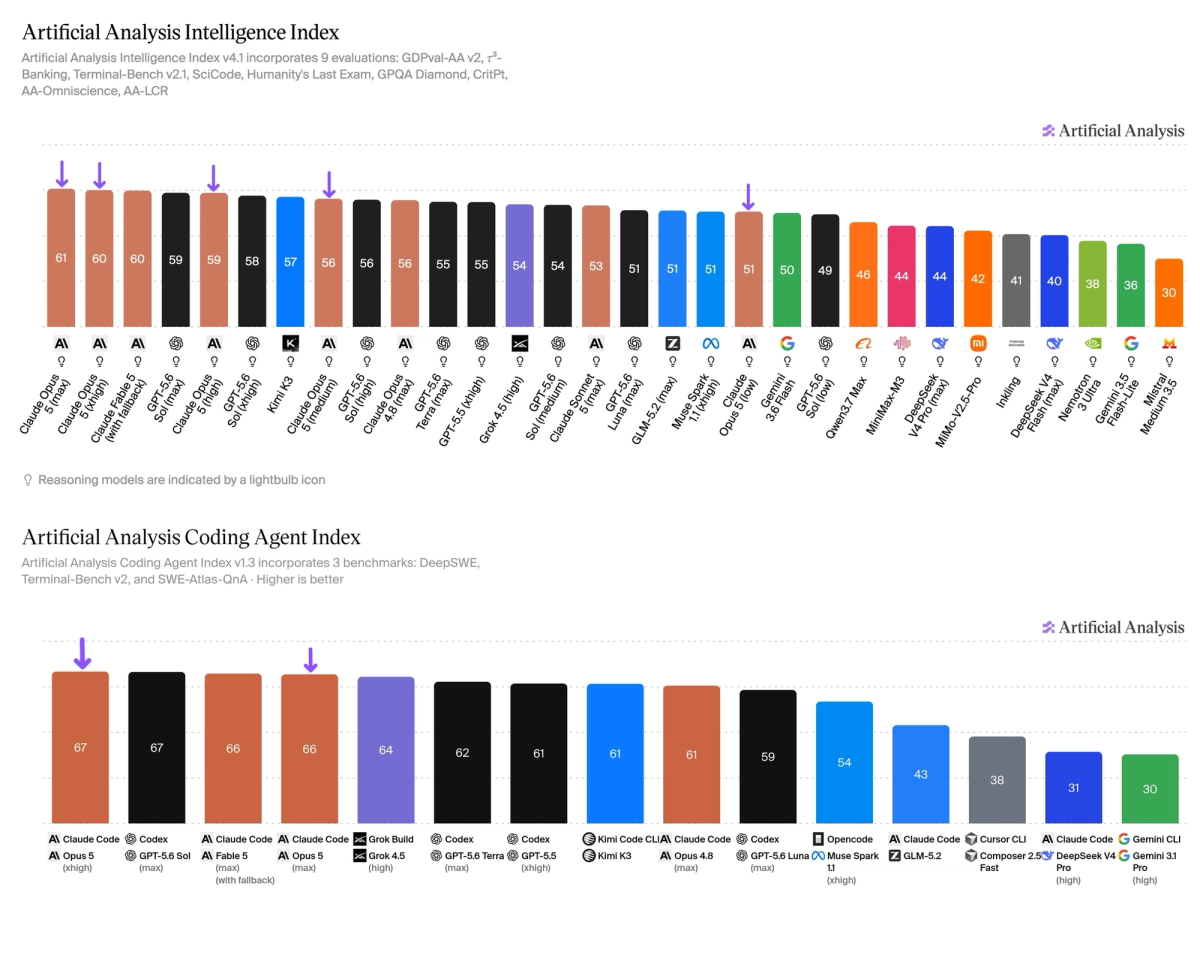
Figure 1. Artificial Analysis Intelligence Index v4.1 and Coding Agent Index v1.3. Source: Artificial Analysis.
Opus 5 max scores 61 on the Intelligence Index; Grok 4.5 high scores 54. This seven-point gap is meaningful on difficult reasoning and agentic work, but it does not imply a 13% improvement in every application. Index points are a composite, not percent accuracy.
On AA-Briefcase, Opus max scores 1720 and Grok high currently scores about 1318. Opus also leads on GDPval-AA v2. For reports, spreadsheets, presentations, and projects spanning many files, the current evidence clearly favors Opus.
Grok's strongest case is a narrower one: complete engineering work at low cost, especially through the Grok Build harness.
Grok's coding-agent efficiency is its differentiator
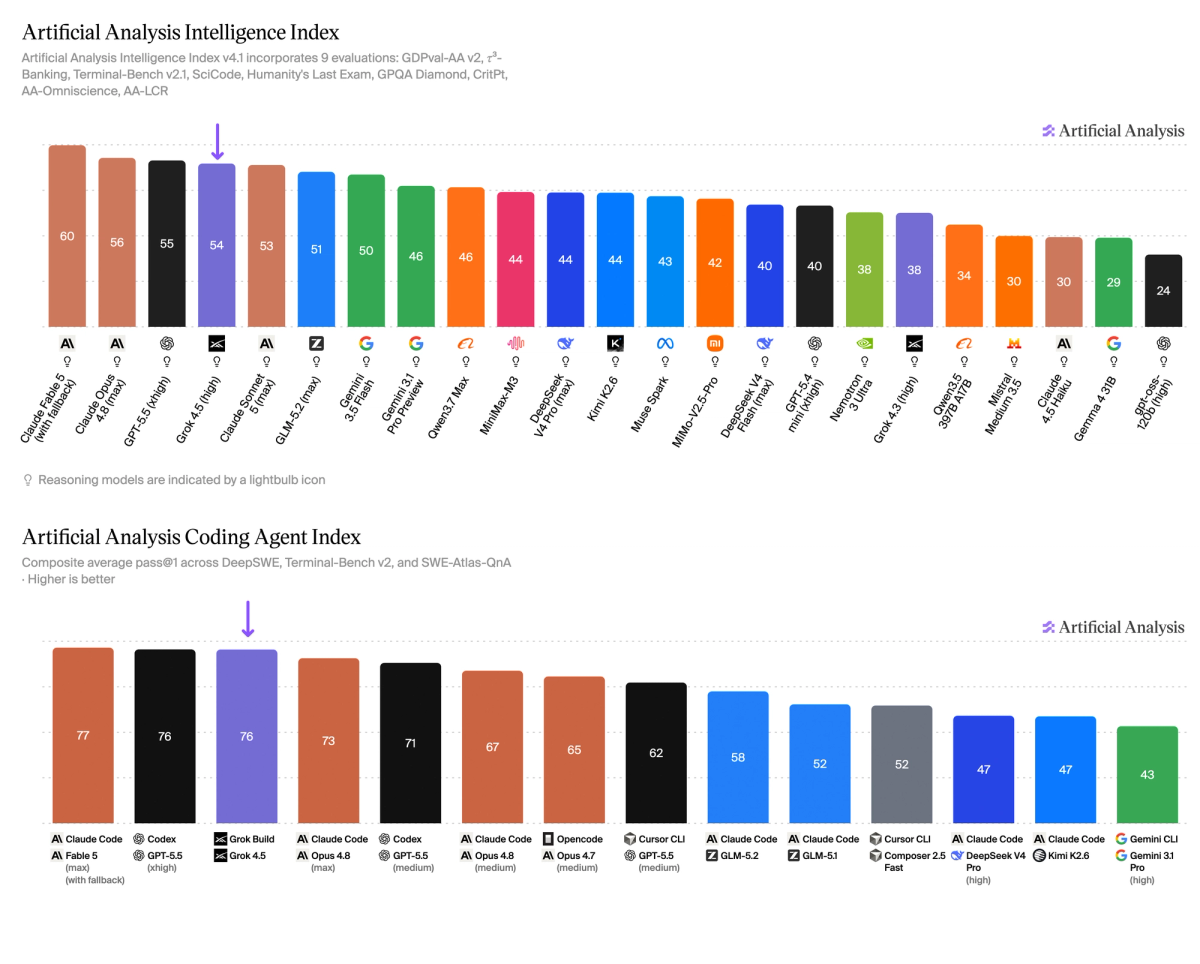
Figure 2. Artificial Analysis Intelligence and Coding Agent Index at Grok 4.5's July 8 evaluation, before GPT-5.6 and Opus 5 entered the updated leaderboard. Source: Artificial Analysis Grok 4.5 analysis.
At launch, Grok 4.5 in Grok Build scored 76 on the then-current Coding Agent Index, level with GPT-5.5 in Codex and one point behind Fable 5 in Claude Code. Artificial Analysis estimated $2.49-$2.59 per coding task, versus $11.80 for Fable and $5.07 for GPT-5.5, driven by lower pricing and fewer tokens.
The updated index now includes newer models and revised scores, so Figure 2 is historical evidence about Grok's efficiency, not the current top-ten order. The broader point survives: Grok used about 1.9 million tokens per Coding Agent Index task in the launch analysis, much less than the compared Claude and GPT systems.
SpaceXAI reports 15,954 average output tokens on SWE-bench Pro tasks for Grok, versus 67,020 for Opus 4.8 max. That comparison does not include Opus 5 and comes from the vendor launch report, so it should motivate a new A/B test rather than be treated as an Opus 5 result.
Coding benchmark results are mixed
SpaceXAI's launch post reports Grok 4.5 at:
- 64.7% on SWE-bench Pro;
- 53% on DeepSWE 1.1;
- 83.3% on Terminal-Bench 2.1;
- 29% on SWE Marathon.
Anthropic reports Opus 5 at 79.2 on SWE-bench Pro and 68.8 on DeepSWE 1.1, with a separate 89% Terminal-Bench v2.1 result in Artificial Analysis's harness. These values are not all same-harness comparisons. Opus appears stronger on repository resolution and frontier reasoning; Grok's efficiency and SWE Marathon result justify a direct trial for long engineering tasks.
Use the same repository set, agent permissions, wall-clock limit, and acceptance tests. Record:
- issue resolution;
- tests passed;
- reviewer edit time;
- unnecessary diff size;
- tool failures and recovery;
- tokens and elapsed time;
- cost per merged result.
Grok is faster and cheaper, but factual reliability needs controls
Artificial Analysis currently measures Grok high around 67.1 output tokens per second and $0.31 per Intelligence Index task, compared with about 52.8 t/s and $2.03 for Opus max. The effort levels differ, yet Grok's price-performance position is strong.
Its AA-Omniscience result is a warning. Grok 4.5 accuracy rose to about 52%, but the reported hallucination rate rose to 54%. A model can know more and still be less willing to abstain. Real-time web and X access in the Grok product can improve freshness, but search does not guarantee source quality or citation correctness.
For news, market monitoring, and current research:
- constrain sources or rank them by authority;
- require citations for each factual claim;
- verify quoted numbers against the opened page;
- label inference separately from sourced fact;
- retain timestamps because live information changes.
Opus also requires retrieval for current facts; its reliable knowledge cutoff is May 2026.
Context and ecosystem create different use cases
Opus's 1M context and 128k output make it better suited to giant codebases, multi-document reviews, and long artifacts. Grok's 500k window is still large, but the 200k billing threshold should be included in cost estimates.
Grok's ecosystem advantage is first-party integration with Grok Build, Cursor, real-time web/X search, and office-product workflows. Opus has Claude Code, broad cloud availability, adaptive effort, prompt caching, and new beta features for tool changes and fallback.
Provider-specific tools are part of the system. A Grok Build score does not automatically transfer to raw grok-4.5 API calls, just as a Claude Code score does not transfer to a bare Messages request.
Scenario decision
| Workload | Start with | Reason |
|---|---|---|
| Highest-stakes codebase change | Opus 5 high/xhigh | Higher current frontier capability |
| Cost-controlled coding agent | Grok 4.5 | Strong launch efficiency and low rates |
| Long report or multi-file analysis | Opus 5 | Much stronger current AA-Briefcase result |
| Current web/X monitoring | Grok ecosystem with verification | Native real-time product integration |
| More than 500k context | Opus 5 | Grok cannot accept the request |
| 200k-500k prompt | Compare retrieval and long-tier cost | Grok's higher price tier applies |
| Interactive technical assistant | Grok or lower-effort Opus | Grok is faster and cheaper in measured configuration |
Where LumeAPI fits
The catalog listed Grok 4.3 at official rates and GPT-5.6 Sol at a discount, but not Grok 4.5 or Opus 5. Do not substitute grok-4.3 results for 4.5 or assume a new model ID works.
LumeAPI's relevance is multi-model evaluation and future routing. One OpenAI-compatible key can call currently listed text, image, and video models, while usage records expose model, tokens, latency, and cost. Add task outcome and quality scores in your application, then compare Grok or Opus only after the exact routes are listed and verified. See the multi-model API hub and model discovery guide.
Final recommendation
Use Opus 5 when the task is hard enough that the highest completion quality outweighs cost and latency. Use Grok 4.5 when coding-agent throughput and cost efficiency dominate, especially if Grok Build or live-search integration is part of the product.
The most economical production design may use both: Grok for first attempts and bounded engineering tasks, Opus for escalations, ambiguous failures, multimodal repository work, and complex final review.