 LumeAPI
Last verified: July 25, 2026
Claude Opus 5 is the stronger model for difficult professional deliverables, complex reasoning, computer use, and long-running agents. Kimi K3 is the lower-priced API and the more strategically interesting option for organizations that want a path toward open-weight deployment. The tradeoff is not simply 61 versus 57 on an intelligence index: Kimi's first-party API is slower, its long-horizon runs use many turns and tokens, and its model weights were promised for July 27 but had not yet been released when this report was verified.
Neither model appeared in the LumeAPI catalog on July 25. This is therefore a source-audited selection guide, not a claim that either model can currently be called through LumeAPI.
Executive Summary
- Choose Opus 5 when accepted-task quality matters most. It leads Kimi on the current Intelligence Index and by a large margin on AA-Briefcase after its July 24 release.
- Choose Kimi K3 when API price, planned weight access, or deployment control matters more. Its official API is $3/$15 per MTok versus $5/$25 for Opus.
- Do not confuse low token rates with low job cost. Kimi averaged 56.4 minutes, 83 turns, and about 120k output tokens per AA-Briefcase task in the pre-Opus comparison.
- Treat open-weight status as pending, not completed. Moonshot stated that K3 weights would be released by July 27. On July 25, Artificial Analysis still classified the tested model as proprietary.
Specifications and deployment boundary
| Dimension | Claude Opus 5 | Kimi K3 |
|---|---|---|
| API model ID | claude-opus-5 | kimi-k3 |
| Input / output | Text and image in; text out | Text and image in; text out |
| Context | 1M tokens | 1,048,576 tokens |
| Official input / output | $5 / $25 per MTok | $3 / $15 per MTok |
| Cache hit | $0.50 per MTok | $0.30 per MTok |
| Output speed measured by AA | About 52.8 t/s at Opus max | About 32.1 t/s |
| Weights | Proprietary | Announced for July 27; not released at verification |
| Primary strength | Complete frontier work | Lower-priced long-context model and deployment option |
Kimi's 40% lower token rates are meaningful. For one million input tokens and 200,000 output tokens, Opus costs $10 and Kimi costs $6 before cache effects. But the same work may not consume the same tokens or number of tool turns, so the $4 difference is not a task-cost forecast.
Sources: Kimi API overview, Kimi K3 pricing, Claude model overview, and Anthropic pricing.
Opus leads current overall and professional-work results
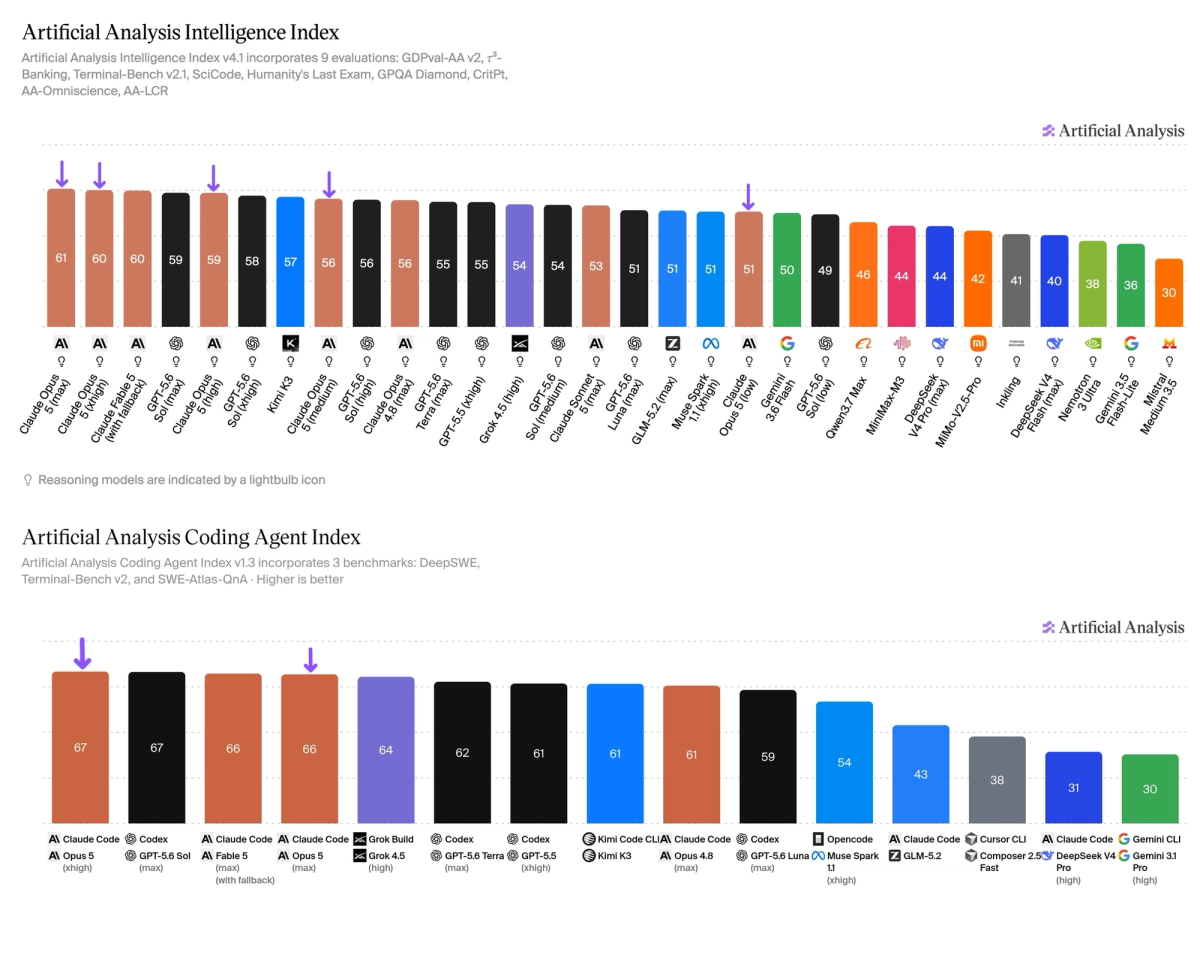
Figure 1. Artificial Analysis Intelligence Index v4.1 and Coding Agent Index v1.3. Source: Artificial Analysis Opus 5 evaluation.
Opus 5 max scores 61 on the Intelligence Index, while Kimi K3 scores 57. Four points is enough to expect a quality difference on some difficult tasks, but Kimi remains in the frontier group rather than a lower commodity tier.
The larger separation is long-horizon knowledge work. Before Opus 5 launched, Kimi K3 scored about 1541-1543 on AA-Briefcase, behind Fable 5 but ahead of GPT-5.6 Sol and Opus 4.8. Opus 5 then raised the leading score to 1720 at max, 1693 at xhigh, and 1606 at high. Even Opus high outscored Kimi in the current leaderboard.
Kimi still shows strong underlying analytical ability. Artificial Analysis measured a 51% rubric pass rate and analytical-quality Elo around 1754, while presentation Elo was lower at 1471. That profile suits research, extraction, structured analysis, and complex back-office work where correctness matters more than visual polish.
Kimi's time and turn count change the cost story
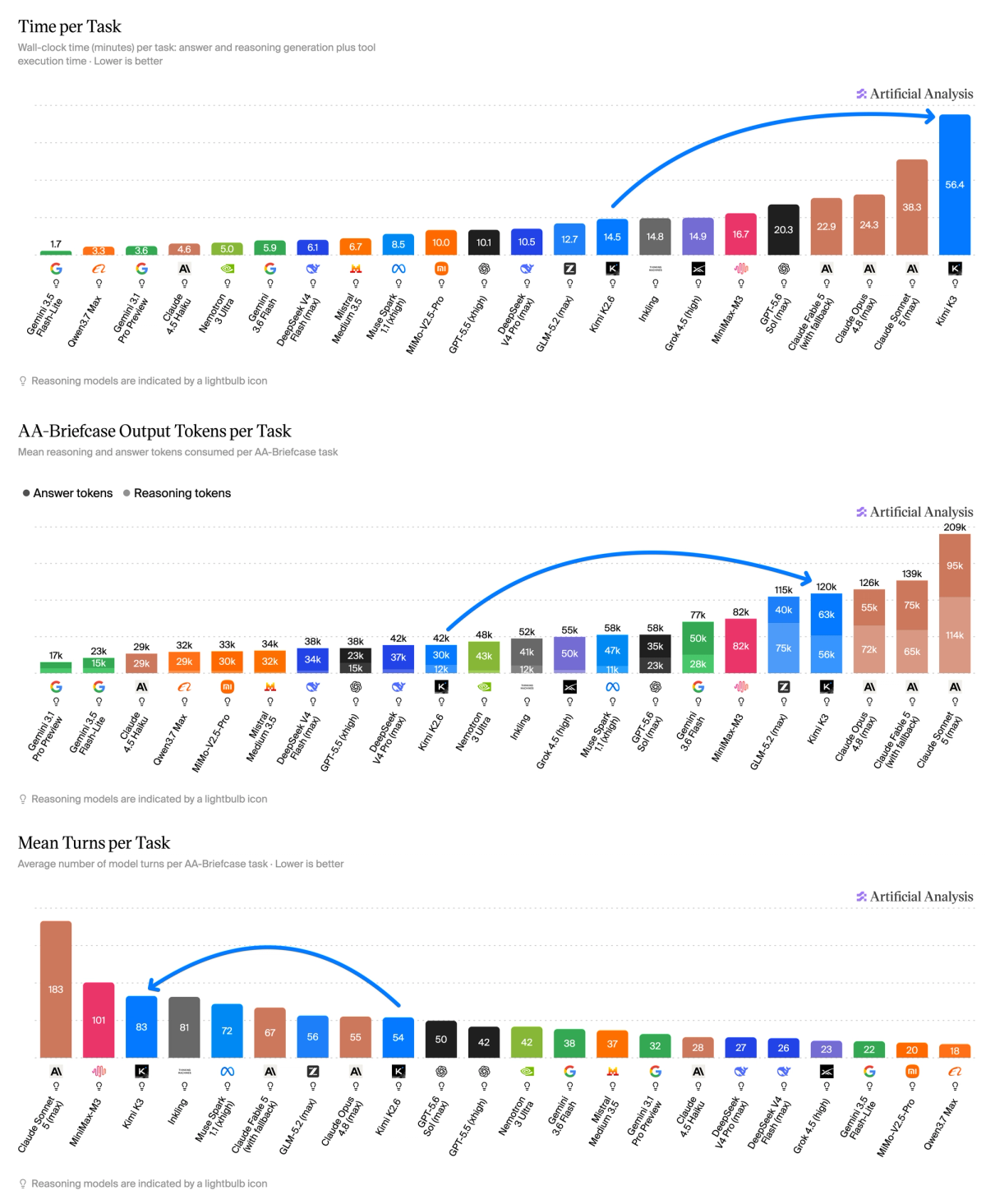
Figure 2. AA-Briefcase time, output-token use, and turns when Kimi K3 was evaluated on July 21, before Opus 5 entered the leaderboard. Source: Artificial Analysis Kimi K3 analysis.
Kimi averaged 56.4 minutes per task, about 120,000 output tokens, and 83 model turns. Artificial Analysis estimated $10.57 per task. The result is an important reminder: a cheaper output-token rate can still produce an expensive workflow if the agent loops for longer.
Opus 5's AA-Briefcase runs also take time—about 36.2 minutes at max, 34.3 at xhigh, and 25.7 at high—but achieve higher Elo. The measured costs were $17.79, $14.26, and $10.41 respectively. Opus high therefore delivered a higher leaderboard score than Kimi at a similar reported task cost and less than half Kimi's average wall-clock time.
For interactive use, neither maximum configuration is attractive. Kimi's lower output speed compounds its long tool loop. Use smaller effort, a shorter task decomposition, or a faster model for user-facing chat, and reserve these agents for asynchronous work.
Coding and frontend work need harness-specific tests
Kimi K3 gained attention for strong frontend generation and long-horizon coding. Opus 5 is joint first in Artificial Analysis's updated Coding Agent Index at xhigh, and Anthropic reports strong SWE-bench Multilingual and Multimodal results.
The missing piece is a clean, same-harness Opus 5 versus Kimi K3 coding table across all current evaluations. Do not combine Moonshot launch claims, Claude Code results, and a separate frontend arena into a homemade winner. Run both models against the same repositories, tool permissions, time limit, and acceptance tests.
Recommended evaluation cuts:
- Existing-code bug fixes with unit tests.
- Screenshot-to-implementation frontend issues.
- Greenfield UI generation judged for functionality and visual similarity.
- Long terminal tasks with recovery from failed commands.
- Minimal-diff pull requests where unnecessary edits count as failures.
Track pass rate, merged-without-edit rate, human review minutes, total tokens, tool turns, elapsed time, and cost per accepted pull request.
The open-weight question is strategically important
Moonshot announced Kimi K3 as a 2.8-trillion-parameter mixture-of-experts model and said full weights would be released by July 27, 2026. Until files and a license are actually published, teams should not design a production self-hosting plan as though the promise were complete.
If the release arrives with commercially usable terms, Kimi can offer advantages Opus cannot:
- deployment inside a controlled network;
- custom inference scheduling and hardware choice;
- model-level experimentation and quantization;
- data-residency options beyond a hosted API;
- reduced dependence on one provider's availability and policy layer.
Those benefits come with substantial costs. A multi-trillion-parameter MoE is not a simple single-GPU deployment. Organizations need serving expertise, capacity planning, observability, security patching, evaluation infrastructure, and a legal review of the eventual license. Open weights can increase control without reducing total cost.
Reliability, factual work, and governance
Kimi's current independent profile is strong but still new. Its high turn count creates more opportunities for tool mistakes, repeated actions, and state drift. Opus has stronger current professional-work evidence, but Anthropic's system card reports that it may answer more readily when uncertain than Opus 4.8.
For both models:
- ground factual work in retrieved sources;
- require citations that resolve to the supplied evidence;
- validate calculations with code;
- use deterministic post-action checks;
- cap turns and cost;
- isolate tools by least privilege;
- retain human approval for irreversible actions.
If Kimi weights become available, self-hosting also transfers security responsibilities to the operator. Model weights do not provide automatic data governance, prompt isolation, audit logs, or abuse controls.
Which model should you choose?
| Application | Recommended start | Reason |
|---|---|---|
| High-stakes report or complex analytical artifact | Opus 5 high/xhigh | Higher current professional-work Elo |
| Long-running general agent | Opus 5 high | Better quality and shorter AA-Briefcase runtime |
| Cost-sensitive API experimentation | Kimi K3 | Lower list rates and cached input |
| Internal deployment or sovereign inference | Wait for verified Kimi weight/license release | Opus weights are closed |
| Presentation-heavy deliverable | Opus, with visual QA | Kimi presentation Elo trails its analytical Elo |
| High-volume chat | Neither at maximum configuration | Use a faster, cheaper model |
| Frontend coding | Same-harness A/B test | Public evidence uses different harnesses |
Where LumeAPI fits
Neither model was listed in the LumeAPI catalog at verification. The correct product workflow is to use the multi-model API hub and usage logs guide to evaluate available substitutes now, then add Opus or Kimi only after exact catalog support is confirmed.
LumeAPI's broader advantage is operational consolidation: one key and wallet can cover multiple LLM families plus image and video models, with per-call records for model, tokens, cost, and latency. Your application should append quality outcome and task ID. That creates the evidence needed to decide whether a premium closed model, a lower-priced hosted model, or a self-hosted open-weight route actually wins.
Final recommendation
Choose Opus 5 for difficult work you need to succeed today. Choose Kimi K3 for lower API rates when its slower, longer agent loops are acceptable, or keep it on the strategic shortlist if the promised weights and license satisfy your deployment requirements after July 27.
Do not buy the headline version of either story. Opus's higher token price can produce a comparable cost per successful long-horizon task; Kimi's planned openness can create deployment control but also transfers infrastructure and security work to you.