 LumeAPI
Last verified: July 25, 2026
Claude Sonnet 5 should handle the majority of everyday production traffic; Claude Opus 5 should receive the smaller set of tasks where a failure or incomplete deliverable costs more than the model premium. Opus leads independent general-intelligence and professional-work evaluations, but Sonnet is faster and costs 60% less at standard rates—or 60% less again under its temporary launch pricing. The most effective architecture is not a permanent winner: route routine work to Sonnet and escalate difficult or failed tasks to Opus.
Neither model appeared in the LumeAPI catalog on July 25, so this report does not claim current LumeAPI access or discounts for either model.
Executive Summary
- Use Sonnet 5 for chat, extraction, classification, routine coding, and high-volume subagents. Its launch rate is $2/$10 per MTok through August 31, then $3/$15.
- Use Opus 5 for complex repositories, long research projects, computer use, and high-value deliverables. It scores 61 versus 53 on the Artificial Analysis Intelligence Index and leads AA-Briefcase by more than 300 Elo.
- Do not run Sonnet at max merely because it is cheaper per token. Independent evaluation found extreme token and turn usage at max, which can erase some savings.
- Migration has a hidden tokenizer change. Sonnet 5 produces roughly 30% more tokens for the same text than Sonnet 4.6, affecting context capacity, output limits, and effective cost.
Specifications and price ladder
| Dimension | Claude Opus 5 | Claude Sonnet 5 |
|---|---|---|
| Model ID | claude-opus-5 | claude-sonnet-5 |
| Context | 1M | 1M |
| Maximum output | 128k | 128k |
| Reliable knowledge cutoff | May 2026 | January 2026 |
| Standard input / output | $5 / $25 per MTok | $3 / $15 per MTok |
| Launch input / output | No temporary discount | $2 / $10 through August 31 |
| Batch at current rate | $2.50 / $12.50 | $1 / $5 through August 31 |
| Comparative latency | Moderate | Fast |
| Adaptive thinking | Default; can disable through high | Default; can disable |
| Effort | low, medium, high, xhigh, max | low, medium, high, xhigh, max |
For one million input tokens and 200,000 output tokens, Opus costs $10. Sonnet costs $4 at the introductory rate and $6 after September 1. Opus therefore needs to save more than $6 in retries, human review, or failed outcomes to justify the premium on that workload.
Sources: Claude models overview, Sonnet 5 migration guide, and Anthropic pricing.
Capability: Opus is a tier above, not a universal default
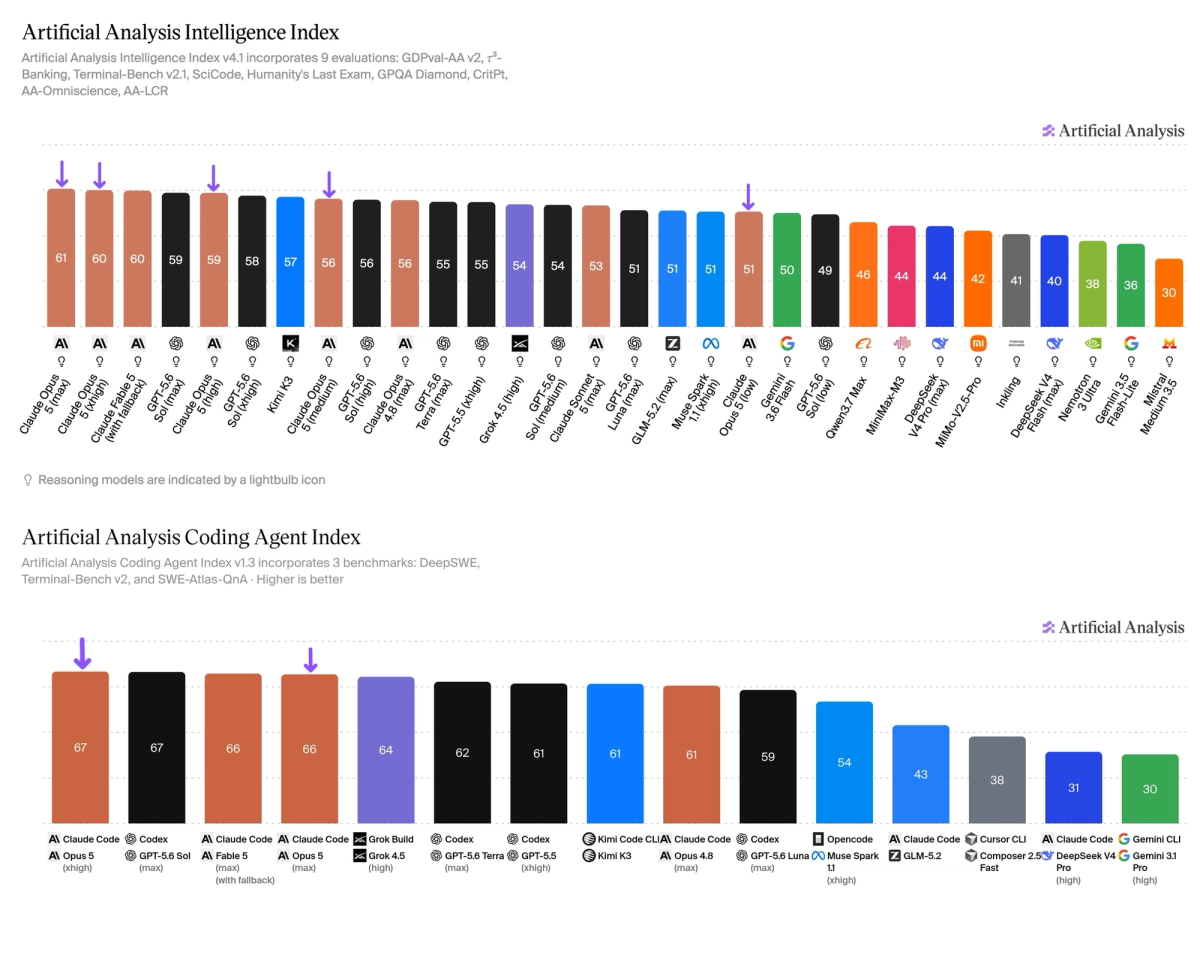
Figure 1. Artificial Analysis Intelligence Index v4.1 and Coding Agent Index v1.3. Source: Artificial Analysis.
Opus 5 max scores 61 and Sonnet 5 max scores 53 on the current independent index. Eight points is a material gap for frontier tasks, but the index does not tell you how often ordinary production prompts need that gap.
The strongest Opus case is complete knowledge work. Opus scores 1720 on AA-Briefcase at max, 1693 at xhigh, and 1606 at high. Sonnet max scores about 1386-1388. The tasks include reports, presentations, spreadsheets, diagrams, and linked files; Opus's advantage reflects completion and analytical quality, not only short-answer reasoning.
On GDPval-AA v2, Opus max reaches 1861 and Sonnet max is substantially lower. For senior-level analysis, multi-file due diligence, difficult planning, or artifacts with many rubric requirements, Opus high is the sensible first trial.
Sonnet max can work too hard
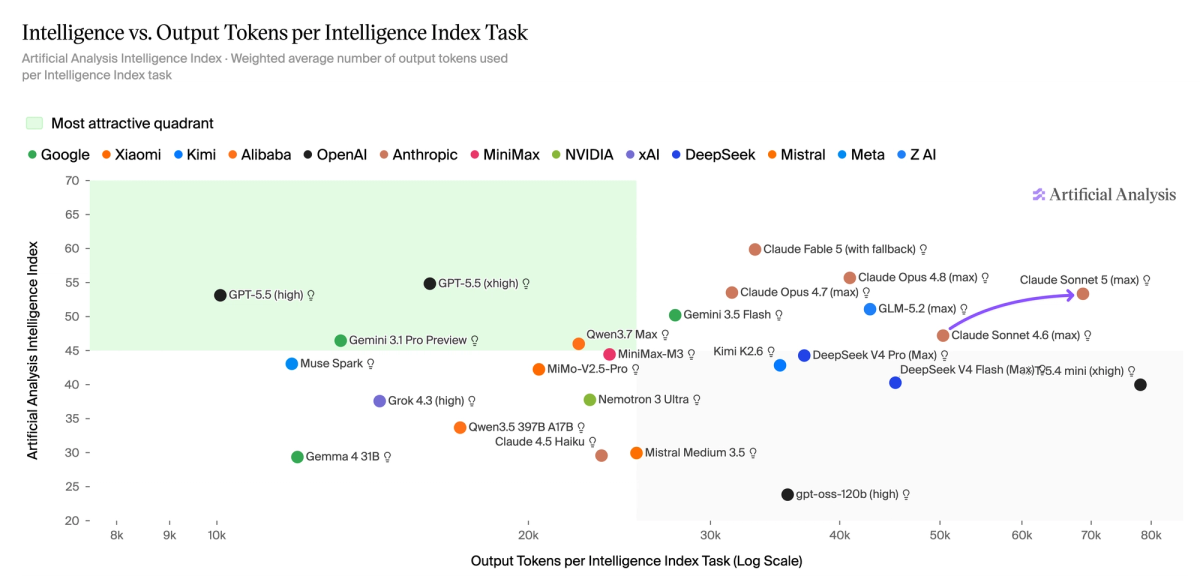
Figure 2. Sonnet 5 max output-token use when evaluated on June 30, before Opus 5 was released. Source: Artificial Analysis Sonnet 5 evaluation.
Artificial Analysis reported that Sonnet max generated around 300 million output tokens across its Intelligence Index run, compared with a 63 million median, and used roughly 40% more output per task than Sonnet 4.6. On GDPval-AA, max used about six times as many turns as low.
This is the trap in a simple “Sonnet is 60% cheaper” calculation. If max effort produces many more reasoning tokens and tool turns, per-task savings narrow. Sonnet's best role is not imitating Opus with unlimited compute; it is delivering sufficient quality at low, medium, or high effort.
Recommended baseline:
- low for triage, extraction, formatting, and simple subagents;
- medium for routine tool use and production drafting;
- high for difficult coding or analysis that still fits the Sonnet tier;
- xhigh/max only after an evaluation shows a measurable accepted-task gain.
Speed and interaction favor Sonnet
Artificial Analysis currently measures Sonnet max around 84 output tokens per second, compared with about 52.8 for Opus max. Maximum reasoning can still create a long time to first answer, so the meaningful comparison is at the effort level you will serve.
For chat, customer support, interactive coding assistance, and multi-agent systems with many parallel workers, Sonnet's faster output and lower base price are more important than Opus's maximum score. Escalate only requests that show complexity signals: repeated tool failure, low retrieval confidence, large dependency graphs, high business impact, or a failed quality gate.
Coding: route by task complexity
Anthropic positions Sonnet 5 as its most agentic Sonnet. It substantially improves over Sonnet 4.6 in coding, tool use, search, and computer operation. Opus 5 nevertheless has the stronger frontier coding and multimodal profile.
Use Sonnet for:
- routine bug fixes with clear tests;
- code explanation and transformation;
- low-risk refactors;
- first-pass pull request review;
- high-volume coding subagents.
Escalate to Opus for:
- ambiguous root-cause analysis across many files;
- visual or screenshot-driven issues;
- long-running tool loops;
- architecture changes with competing constraints;
- failures that survived one Sonnet repair cycle.
Always measure merged-without-edit rate and reviewer time. A cheaper model that creates more review work may be more expensive than Opus; an Opus agent that over-refactors can also lose.
The tokenizer change affects effective cost
Anthropic states that Sonnet 5's new tokenizer produces approximately 30% more tokens for the same text than Sonnet 4.6, varying by content. This has three consequences:
- A 1M-token window holds less equivalent text than the previous tokenizer.
- Existing
max_tokenslimits may truncate an otherwise equivalent answer. - The same document can cost more even though the published per-token rate is unchanged.
Recount representative prompts with Sonnet 5 before migrating. Do not reuse historical tokens-per-document or cost forecasts from Sonnet 4.6.
Sonnet 5 also rejects manual extended thinking and non-default temperature, top_p, or top_k settings with HTTP 400. Use adaptive thinking and effort instead. Opus 5 shares adaptive thinking but has different limits when thinking is disabled at xhigh or max.
A practical two-tier router
| Task signal | Route |
|---|---|
| Short, reversible, high-volume | Sonnet low/medium |
| Clear coding task with tests | Sonnet medium/high |
| Large context but simple extraction | Sonnet low with retrieval/cache |
| Multi-file analytical deliverable | Opus high |
| Repeated tool failure or incomplete rubric | Escalate Sonnet to Opus |
| Irreversible external action | Either model plus human approval |
| Hard task with strict latency budget | Parallel Sonnet and selective Opus |
Do not route using prompt length alone. A short legal judgment can be high impact, while a long extraction can be mechanically simple. Combine complexity, consequence, latency, and quality-gate signals.
Where LumeAPI fits
Opus 5 and Sonnet 5 were not listed in the catalog at verification. The currently listed Claude routes were older Opus and Sonnet models. Confirm current models before sending a new ID.
LumeAPI's product fit is the routing layer: one OpenAI-compatible key, one wallet, and request logs can compare several currently available LLMs without separate provider clients. The same account can also reach image and video models. Add application-level task IDs and acceptance outcomes to LumeAPI's token, cost, model, and latency records, then implement the Sonnet-to-Opus policy only when both exact routes are verified.
See the Claude API hub, multi-model API, and usage-log implementation guide.
Final recommendation
Make Sonnet 5 the volume tier and Opus 5 the escalation tier. Opus earns its premium on complex deliverables, difficult repositories, and long-horizon agents where higher success reduces human work. Sonnet wins routine production work when effort is controlled.
Revisit the economics before September 1, 2026. Sonnet's official price rises from $2/$10 to $3/$15, and its tokenizer means historical Sonnet 4.6 cost models are not directly reusable.