 LumeAPI
Last verified: July 25, 2026
Claude Opus 5 is the better default for most teams choosing between Anthropic's two frontier tiers. It reaches essentially the same overall intelligence as Fable 5, leads it on current professional-work and automation evaluations, costs half as much per token, and gives developers five effort settings instead of an always-on maximum-compute profile. Fable 5 still has narrow advantages in factual knowledge and several coding benchmarks, and its stricter safety-classifier architecture may be desirable for some regulated deployments. Those advantages are real, but they no longer justify making Fable the automatic premium choice.
This comparison uses current first-party specifications, Anthropic's Opus 5 system card, and independent Artificial Analysis results. It is not a hands-on Opus 5 test through LumeAPI. The live LumeAPI catalog listed Fable 5 at $5/$25 per million input/output tokens on July 25—50% below Anthropic's official reference rates—while Opus 5 was not listed. Any LumeAPI comparison on this page therefore applies only to the verified Fable route.
Executive Summary
- Choose Opus 5 for most difficult production work. It scores 61 versus Fable's 60 on the Artificial Analysis Intelligence Index, while costing $5/$25 instead of $10/$50 per million input/output tokens.
- Fable remains slightly stronger on some knowledge and coding tests. It edges Opus on Humanity's Last Exam without tools, SWE-bench Pro, DeepSWE, and FrontierCode, but the margins are small and harness-specific.
- Opus is decisively stronger on complete deliverables and automation. It leads Fable by 114 Elo on GDPval-AA v2, 146 Elo on AA-Briefcase, and roughly nine percentage points on AutomationBench.
- The operational difference is flexibility. Opus supports low, medium, high, xhigh, and max effort. Fable uses adaptive reasoning at maximum effort and may fall back to Opus 4.8 when safety classifiers flag a request.
- LumeAPI changes the immediate buying decision. Fable is currently callable through LumeAPI at $5/$25, the same rates as Opus 5's official list price; Opus 5 must wait for verified catalog support.
Specifications and cost
| Dimension | Claude Opus 5 | Claude Fable 5 | Decision impact |
|---|---|---|---|
| API model ID | claude-opus-5 | claude-fable-5 | Both are pinned, dateless model IDs |
| Context window | 1M tokens | 1M tokens | No long-context capacity advantage |
| Maximum output | 128k tokens | 128k tokens | Both can produce large artifacts |
| Reliable knowledge cutoff | May 2026 | January 2026 | Opus has the newer documented cutoff |
| Standard input / output | $5 / $25 per MTok | $10 / $50 per MTok | Fable is exactly 2× the list rate |
| Cache hit | $0.50 per MTok | $1 per MTok | Same 90% discount, different base |
| Batch input / output | $2.50 / $12.50 | $5 / $25 | Same 50% Batch discount |
| Effort control | low through max | max profile | Opus supports cost-quality routing |
| Safety fallback | Optional server fallback beta | Classifier-triggered fallback | Fable behavior can involve a second model |
For a workload with one million input tokens and 200,000 output tokens, Opus costs $10 at list price; Fable costs $20. If Fable produced a reliably better result twice as often, that premium could be rational. The current evidence instead shows near-ties on general intelligence and several coding tests, with Opus ahead on full professional deliverables.
Sources: Claude model overview, Fable 5 documentation, and Anthropic pricing.
Overall intelligence is effectively tied
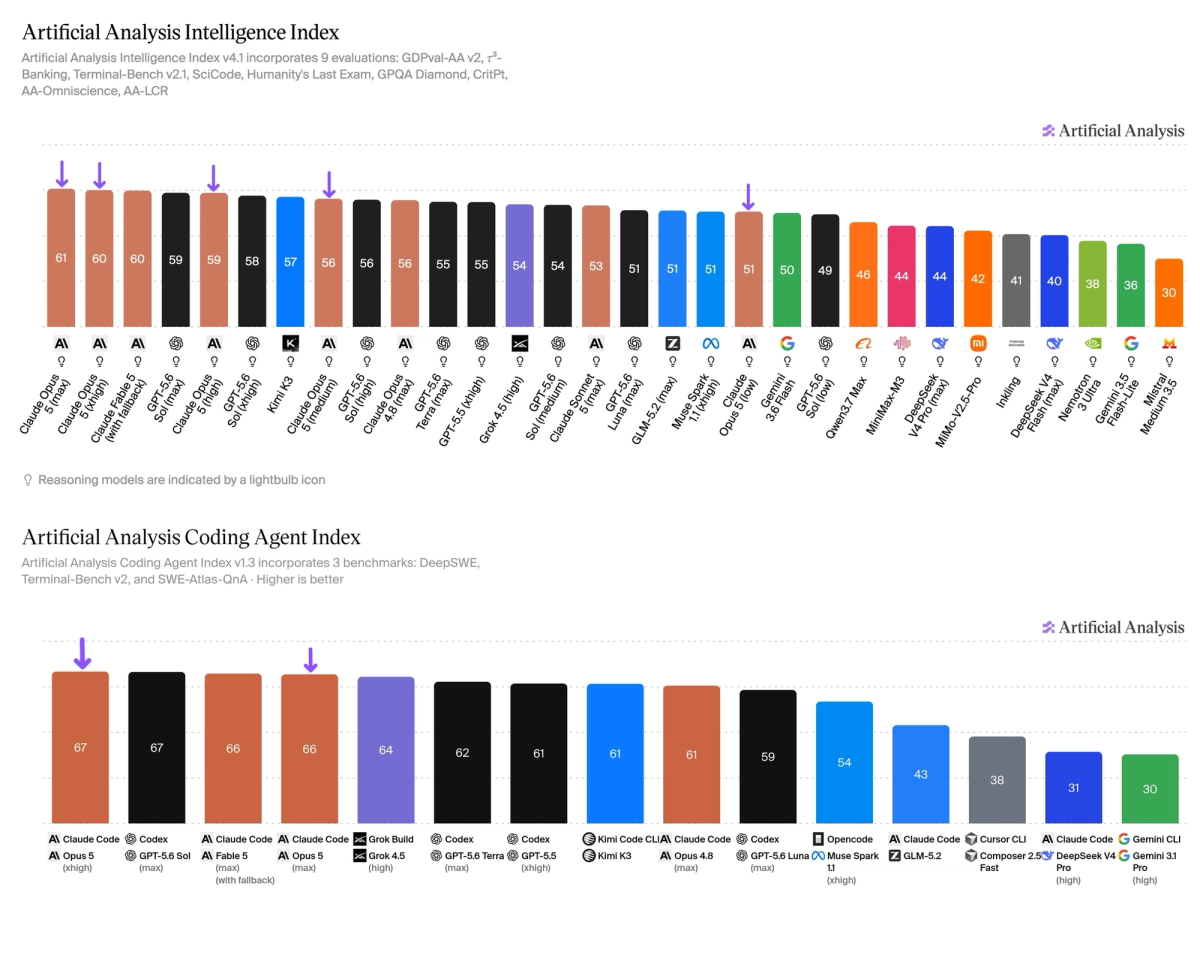
Figure 1. Artificial Analysis Intelligence Index v4.1 and Coding Agent Index v1.3 after the Opus 5 release. Source: Artificial Analysis. Composite index points are not percentage accuracy.
Opus 5 at max scores 61 and Fable 5 with fallback scores 60. A one-point gap is better treated as a statistical near-tie than a meaningful new intelligence class. The practical difference is that Opus reaches this tier at a reported $2.03 per Intelligence Index task, versus $2.75 for Fable. At lower effort, Opus can trade some capability for materially fewer tokens; Fable does not offer the same ladder.
The composite hides one reason to retain Fable. Artificial Analysis reports that Fable has stronger factual knowledge on AA-Omniscience. Opus 5 improved accuracy over Opus 4.8 but answered more readily when uncertain, producing a 50% hallucination rate in that closed-book setup. For high-stakes fact retrieval, neither result supports closed-book deployment: use search or retrieval, require citations, and measure supported-answer accuracy.
Complete knowledge work favors Opus
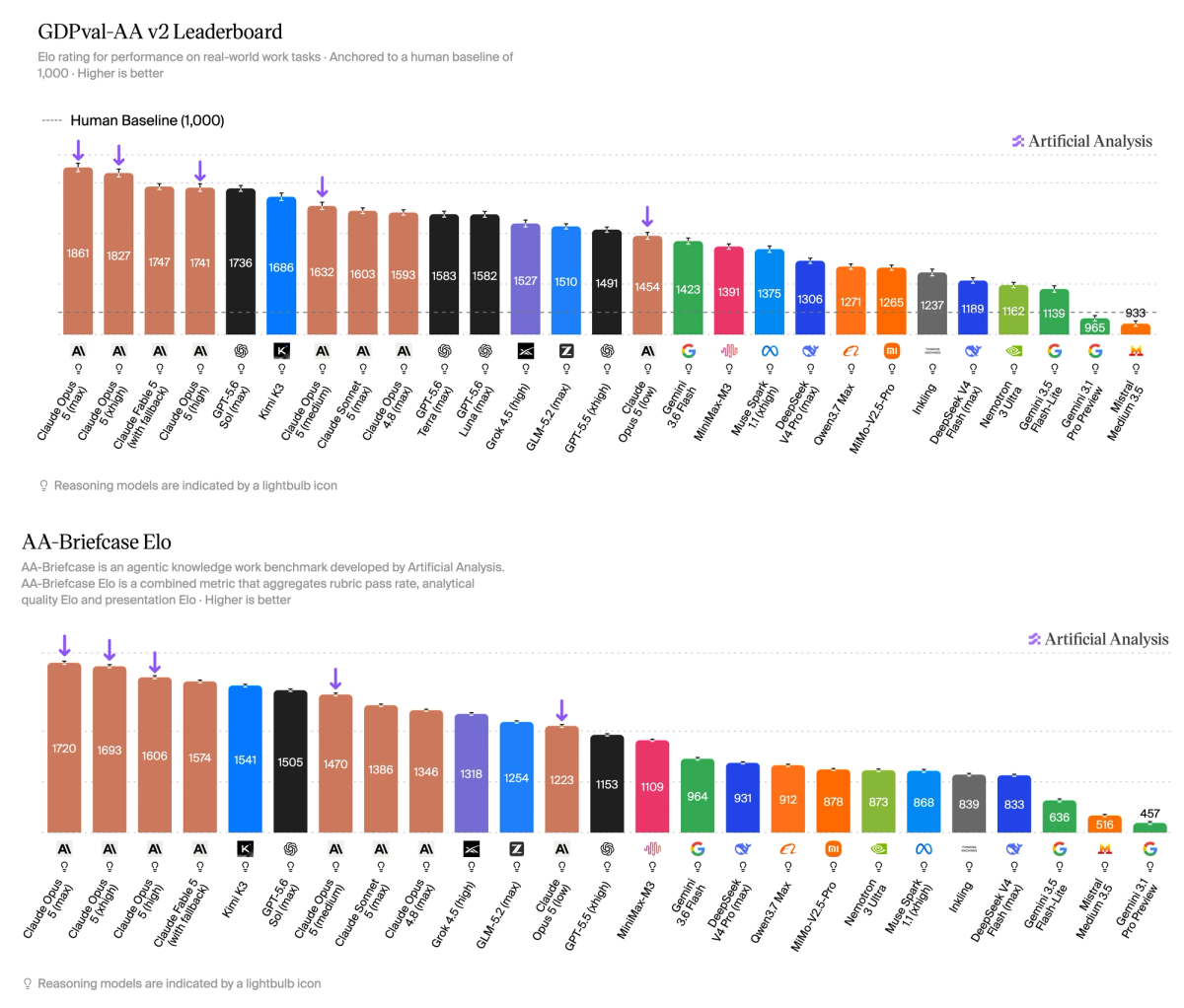
Figure 2. GDPval-AA v2 and AA-Briefcase Elo ratings with confidence intervals. Source: Artificial Analysis Opus 5 evaluation. Elo is a relative pairwise rating, not percent correct.
Opus 5 records 1861 Elo on GDPval-AA v2, compared with 1747 for Fable. On AA-Briefcase, which requires reports, spreadsheets, presentations, and other deliverables across linked source files, Opus scores 1720 versus 1574. The result matters because these tests measure completion of a work product rather than a short answer.
The cost comparison strengthens the conclusion. Artificial Analysis measured $17.79 per AA-Briefcase task for Opus max and $22.30 for Fable. Opus xhigh scored 1693 at $14.26, still above Fable while lowering task cost by about 36%. Opus high scored 1606 at $10.41, also above Fable in the published leaderboard.
For research, financial models, document packs, and multi-file analysis, start with Opus high. Move to xhigh when rubric completion or cross-file reasoning remains weak. Fable should be the challenger, not the default.
Coding is closer than the headline suggests
Anthropic's Opus 5 system card reports:
| Coding evaluation | Opus 5 | Fable 5 | Better result |
|---|---|---|---|
| SWE-bench Pro | 79.2 | 80.0 | Fable, narrowly |
| SWE-bench Multilingual | 89.5 | 86.6 | Opus |
| SWE-bench Multimodal | 59.4 | 54.1 | Opus |
| DeepSWE v1.1 | 68.8 | 69.7 | Fable, narrowly |
| FrontierCode main | 53.4 | 53.5 | Effective tie |
| Frontier-Bench | 43.3 | 33.8 | Opus |
These are not six votes that should be averaged. SWE-bench Multimodal is especially relevant when issues include screenshots or visual specifications; DeepSWE is more representative of terminal-driven implementation; Frontier-Bench emphasizes long-running agentic coding. Choose the evaluation that resembles the repository and agent harness you actually operate.
Opus also has a scope-control lesson: its best FrontierCode result occurred at medium effort, not max. Higher effort sometimes caused unnecessary refactors. For bounded pull requests, test medium and require a minimal diff. For long-running debugging or multimodal frontend work, high or xhigh is more defensible.
Automation and computer use widen the gap
Zapier's deterministic AutomationBench leaderboard reports Opus 5 max at 26.2%, compared with Fable 5 at 17.4%. Opus medium reaches 23.6% at lower cost than Opus max. On OSWorld 2.0, Anthropic reports 70.6 for Opus and 66.1 for Fable.
The absolute AutomationBench result is also a warning: even Opus fails nearly three quarters of strict end-state tasks. Neither model should be permitted to send money, delete records, publish content, or contact customers without idempotency, allowlisted tools, post-action state checks, and approval gates.
Fable's safety architecture can change behavior and billing
Fable 5 adds classifiers for high-risk cyber, biology, chemistry, and model-distillation requests. A refusal can return HTTP 200 with stop_reason: "refusal". With fallback configured, flagged content may be routed to Opus 4.8 instead. Artificial Analysis observed fallback on roughly 8% of its original Intelligence Index tasks, concentrated in science-heavy evaluations, while Anthropic states average session fallback is below 5%.
That means a Fable result may represent a system consisting of Fable, classifiers, and a fallback model. This is not inherently bad; it may be exactly what a security-sensitive organization wants. But evaluation logs should record the served model, fallback event, refusal reason, tokens, and final task outcome. Otherwise a team can attribute success, cost, or failure to the wrong component.
Which model should you choose?
| Application | Recommended starting model | Why |
|---|---|---|
| Complex report, spreadsheet, or research artifact | Opus 5 high/xhigh | Strongest current professional-work results |
| Long-running coding agent | Opus 5 xhigh | Better Frontier-Bench and flexible effort |
| Small, tightly scoped pull request | Opus 5 medium; test Fable | Avoid Opus over-refactoring |
| Multilingual or screenshot-driven issue | Opus 5 high | Better multilingual and multimodal SWE results |
| Closed-book factual challenge | Fable 5, with verification | Stronger AA-Omniscience profile |
| Strictly governed high-risk domains | Evaluate Fable system | Classifiers and fallback may match policy needs |
| High-volume routine work | Neither | Use Sonnet-class or another cheaper model |
Where LumeAPI fits
The LumeAPI Fable 5 model page listed claude-fable-5 at $5 input and $25 output per million tokens when checked on July 25. That is 50% below Anthropic's $10/$50 reference rates and exactly matches Opus 5's official $5/$25 list rates. Opus 5 was not in the live catalog, so do not guess its model ID against the gateway or assume it receives the same discount.
This creates a useful near-term choice. A team can call the verified Fable route through one OpenAI-compatible LumeAPI integration and evaluate its hardest tasks now, while keeping currently listed GPT and lower-cost Claude routes behind the same key and wallet. Per-call logs expose the served model, token use, cost, and latency; the application should add task IDs and acceptance outcomes so the real metric becomes cost per accepted task.
Before production, verify Fable's exact context behavior, tool support, refusal handling, and fallback semantics against your workload. If Opus 5 is later added, rerun the same representative task set instead of transferring Anthropic's official price comparison to an unverified LumeAPI route. See the multi-model API hub, usage-log guide, and broader Opus 5 review for the evaluation framework.
Final recommendation
Use Opus 5 as the default frontier Claude model when you can access and validate it directly. It preserves Fable-level general capability, improves complete knowledge work and automation, and halves Anthropic's official Fable token rates. For LumeAPI users on July 25, Fable is the immediately deployable option: its verified 50% discount brings its portal rates down to Opus 5's official list rates. Keep Fable as the production route for hard factual-knowledge and safety-governed workloads while treating Opus as a future same-task challenger after catalog support appears.
Re-evaluate this decision with your own tasks. A five-point benchmark lead that does not resemble the workflow is less useful than a one-point gain in accepted deliverables, merged pull requests, or correctly completed business actions.