 LumeAPI
Last verified: July 25, 2026
Claude Opus 5 is the strongest practical Claude choice for difficult agentic coding, professional knowledge work, computer use, and long-running workflows when you want near-Fable capability at half Fable 5's token price. It is not the automatic winner for every coding benchmark, high-volume chat, or unsupervised fact-heavy work. For most production trials, high is the right baseline and xhigh is the next step for long-horizon agents; reserve max for tasks where your own evaluation shows that the extra time and output tokens improve completed-task success.
This is a source-audited benchmark and deployment review, not a claimed hands-on test through LumeAPI. Anthropic released Opus 5 on July 24, 2026, but the live LumeAPI model catalog did not list claude-opus-5 when checked on July 25. The report therefore does not claim current LumeAPI availability, latency, pricing, or discount for Opus 5.
Executive verdict
The release matters because Opus has moved from a premium reasoning model to a serious daily agent model. Opus 5 keeps the same official $5 input and $25 output price per million tokens as Opus 4.8, while closing much of the gap to Fable 5 and beating it on several professional-work and automation evaluations. It also adds a 1 million-token context window, 128,000-token maximum synchronous output, adaptive thinking by default, five effort levels, lower prompt-cache minimums, mid-conversation tool changes in beta, server-side fallback options, and an API-only fast mode.
Its clearest advantage is long-horizon work, not short chat. Artificial Analysis places Opus 5 at 61 on its Intelligence Index, one point above Fable 5 and two above GPT-5.6 Sol. On GDPval-AA v2 and AA-Briefcase, the model leads at max, xhigh, and in some cases high, indicating unusually strong performance on complete professional deliverables rather than only short-form question answering.
The model still has important counter-evidence. GPT-5.6 Sol remains ahead on DeepSWE v1.1; Fable 5 narrowly leads FrontierCode's main set; Opus 5's best FrontierCode result occurs at medium, because higher effort can create unnecessary refactors. Independent testing measured about 52.8 output tokens per second at max and described the model as slow and verbose. Anthropic's system card also reports higher factual accuracy than Opus 4.8 but a higher hallucination rate on a closed-book benchmark.
The practical recommendation is selective routing. Use Opus 5 for difficult codebase work, complex research artifacts, computer-use agents, document-heavy analysis, and business workflows where one successful completion is worth more than raw token efficiency. Use Sonnet-class or other lower-cost models for routine chat, classification, extraction, simple drafting, and high-volume subagents. Use GPT-5.6 Sol when its stronger DeepSWE, terminal, speed, or presentation profile better matches the task.
Specifications that change deployment decisions
| Dimension | Claude Opus 5 | Practical implication |
|---|---|---|
| API model ID | claude-opus-5 | Dateless but pinned model ID, not an evergreen alias |
| Input / output | Text and images in; text out | Vision analysis is supported; this is not an image-generation model |
| Context window | 1M tokens | Full window is included at standard token rates |
| Max synchronous output | 128k tokens | Large deliverables are possible, but max_tokens includes thinking and visible output |
| Reliable knowledge cutoff | May 2026 | Newer facts still require search, retrieval, and citations |
| Standard price | $5 input / $25 output per MTok | Same list price as Opus 4.8 and half Fable 5's token rates |
| Prompt cache | $6.25 5-minute write; $10 1-hour write; $0.50 hit | Reused tools, policies, and long reference packs can sharply reduce repeated input cost |
| Batch price | $2.50 input / $12.50 output per MTok | Useful for non-urgent offline evaluation and document jobs |
| Fast mode | $10 input / $50 output per MTok | API-only research preview; doubles token rates and cannot be combined with Batch |
| Effort | low, medium, high, xhigh, max | high is the API and Claude Code default |
Sources: Anthropic models overview, Opus 5 API changes, and Anthropic pricing.
The 1M window deserves a precise interpretation. It removes an older long-context price cliff: Anthropic states that a 900k-token request uses the same per-token rate as a 9k-token request. It does not make a 900k prompt cheap, fast, or necessarily more accurate than retrieval. A one-million-token input alone costs $5 at the standard rate before output, tools, retries, cache writes, or regional premiums. Long-context architecture still needs retrieval, deduplication, prompt caching, and relevance tests.
How to read the benchmark evidence
A benchmark score is meaningful only with its harness, effort level, tools, number of trials, and grading method. This report separates three evidence classes:
- Vendor-reported evaluations: Anthropic's system card and launch charts contain the widest comparison set, generally using Opus 5 at adaptive thinking and
max, often averaged over five trials. Some evaluations use internal harnesses, safety classifiers, or Opus 4.8 fallback. - Independent evaluations: Artificial Analysis ran its Intelligence Index, Coding Agent Index, GDPval-AA v2, and AA-Briefcase. These are more useful for cross-provider comparisons, but some tasks are private and several scores use LLM judges or Elo rather than deterministic unit tests.
- Benchmark-owner results: ARC Prize verifies ARC-AGI results, while Zapier's AutomationBench grades simulated application state with deterministic assertions. These are strong signals for their narrow tasks, not universal measures of model quality.
Do not average percentages from SWE-bench, ARC-AGI, OSWorld, and AutomationBench into one homemade score. Their populations, denominators, agent scaffolds, effort settings, costs, and graders are different. The useful question is which benchmark resembles the application you intend to build.
Overall intelligence and coding-agent position
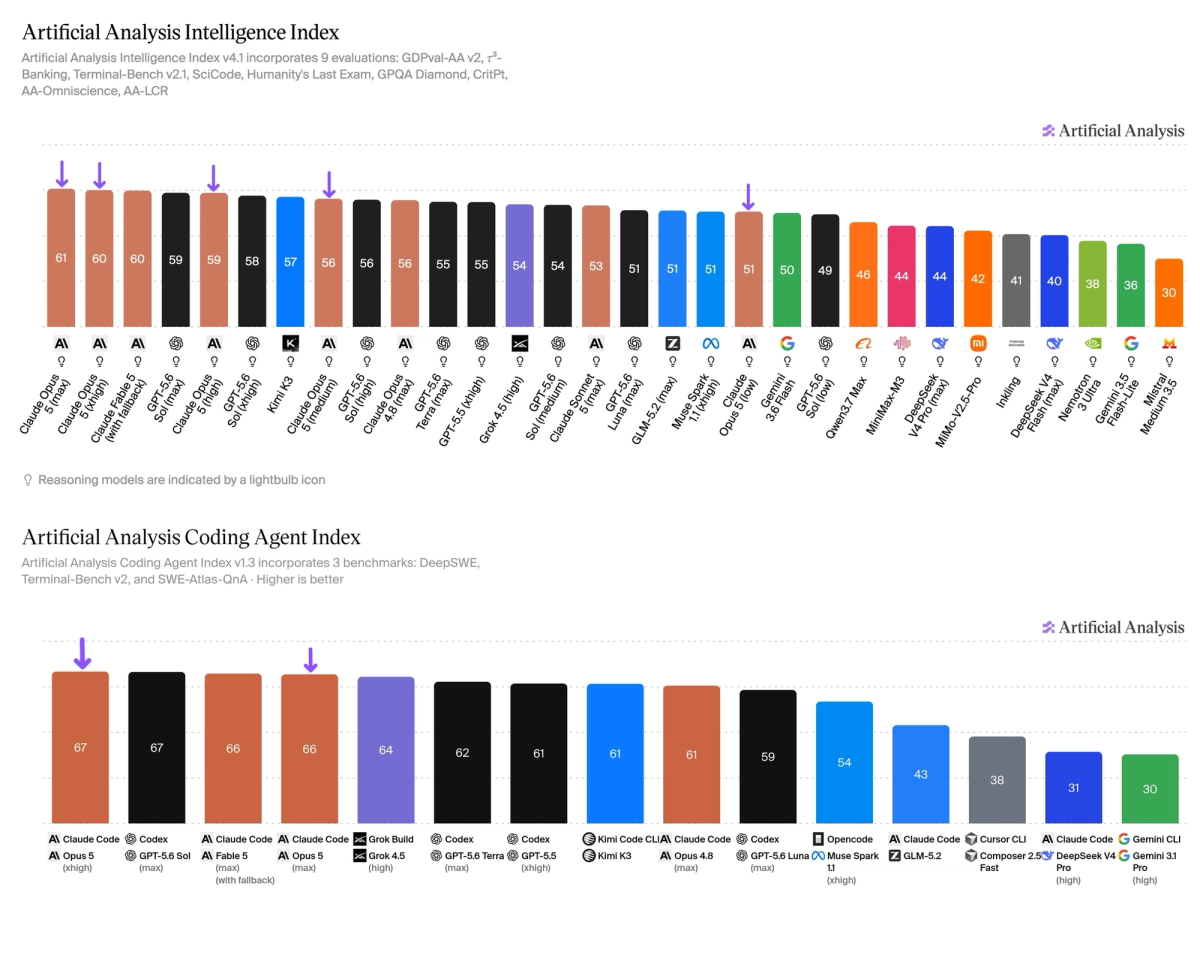
Figure 1. Artificial Analysis Intelligence Index v4.1 and Coding Agent Index v1.3, July 24, 2026. Source: Artificial Analysis Opus 5 evaluation. The composite index combines multiple benchmarks; it is not a percentage accuracy score.
On the independent Intelligence Index, Opus 5 max scores 61, Fable 5 scores 60, GPT-5.6 Sol max scores 59, Kimi K3 scores 57, and Opus 4.8 max scores 56. A one-point lead should be treated as a near tie, not a new category of intelligence, because index composition and measurement noise matter. The useful result is that Opus 5 belongs in the same frontier tier as Fable and Sol while its standard token price is lower than Fable's.
The coding result is similarly nuanced. Claude Code with Opus 5 xhigh and Codex with GPT-5.6 Sol max both score 67 on the Artificial Analysis Coding Agent Index. Opus 5 max and Fable 5 max score 66. The model therefore has a strong coding-agent profile, but the agent scaffold and effort setting are part of the product being measured. The chart does not prove that a raw API completion will reproduce Claude Code's result.
Anthropic's system card provides a more granular coding picture:
| Benchmark | Opus 5 | Opus 4.8 | Fable 5 | GPT-5.6 Sol | Interpretation |
|---|---|---|---|---|---|
| SWE-bench Pro | 79.2 | 69.2 | 80.0 | 64.6 | Opus nearly matches Fable and clearly improves on 4.8 |
| SWE-bench Multilingual | 89.5 | 84.4 | 86.6 | not reported | Strong multi-language repository work |
| SWE-bench Multimodal | 59.4 | 38.4 | 54.1 | not reported | Large gain when issues include screenshots or mockups |
| DeepSWE v1.1 | 68.8 | 59.0 | 69.7 | 72.7 | GPT-5.6 Sol remains the leader |
| FrontierCode 1.1 Main | 53.4 | 46.5 | 53.5 | 47.5 | Opus is essentially tied with Fable, but not first |
| Frontier-Bench v0.1 | 43.3 | 21.1 | 33.8 | 34.4 | Opus leads this agentic coding benchmark |
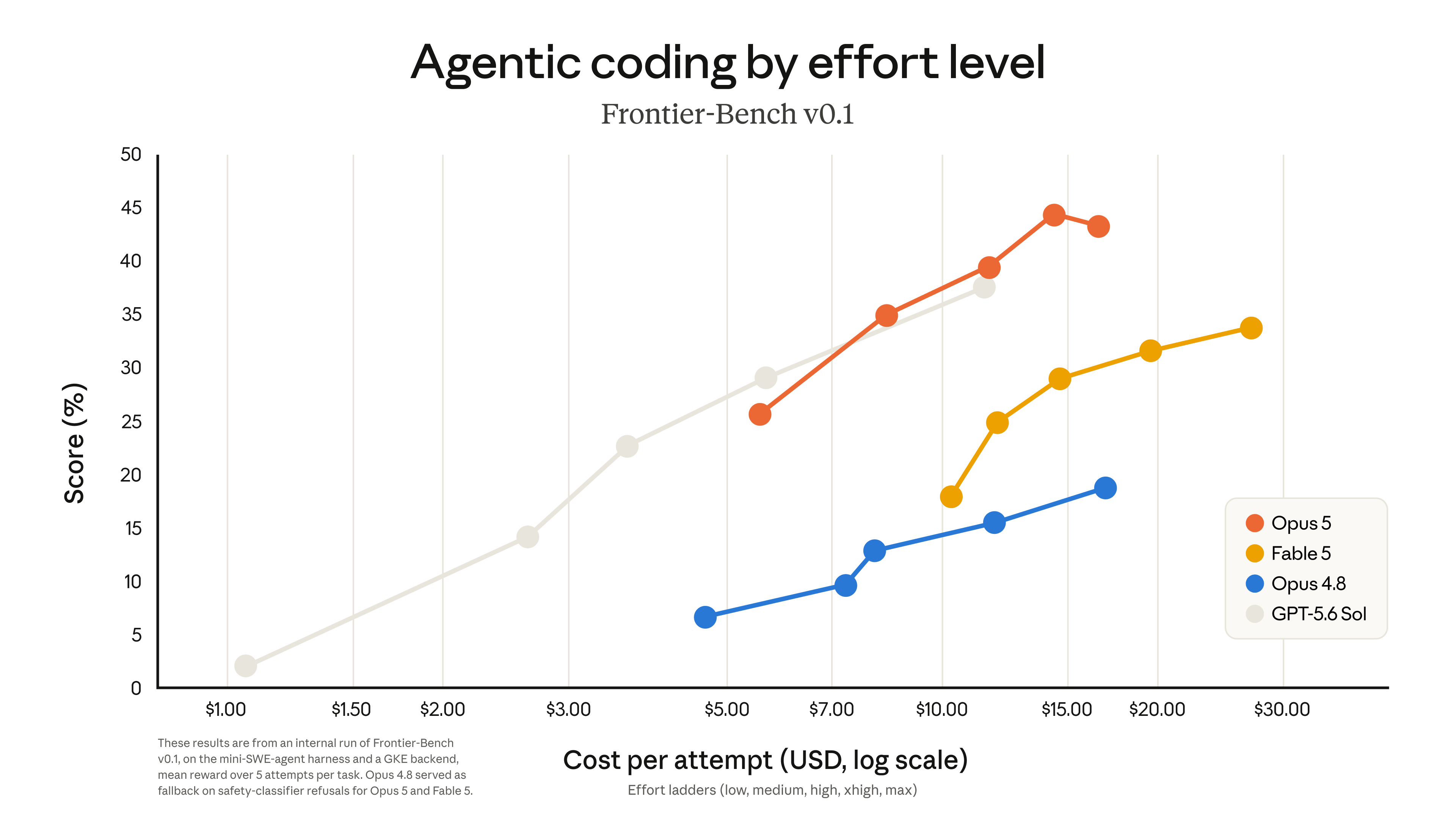
Figure 2. Frontier-Bench v0.1 score versus cost per attempt on a logarithmic x-axis. Source: Anthropic launch report. This is an Anthropic-reported internal run; the model curves include different effort settings and fallback rules.
The most actionable coding caveat is hidden behind the headline. Anthropic reports that Opus 5's FrontierCode score declines above high, because higher effort can make more changes than the task requires. Its best main-set score, 53.4, occurs at medium. Adding a prompt to stay within scope recovered much of the loss, but the official score uses the unchanged benchmark prompt. For code review and pull requests, more reasoning is not automatically better; constrain scope, require a minimal diff, and evaluate merged changes rather than lines written.
Coding recommendation
Use high as the first production baseline for difficult bug fixing, multi-file features, visual issue reproduction, and repository analysis. Test medium for bounded pull requests where minimal diffs matter. Raise to xhigh for genuinely long tasks with tool loops, but keep change budgets, test gates, and rollback controls. Run GPT-5.6 Sol alongside Opus 5 for DeepSWE-like terminal and implementation tasks instead of assuming one model owns all coding work.
Professional knowledge work is Opus 5's strongest case
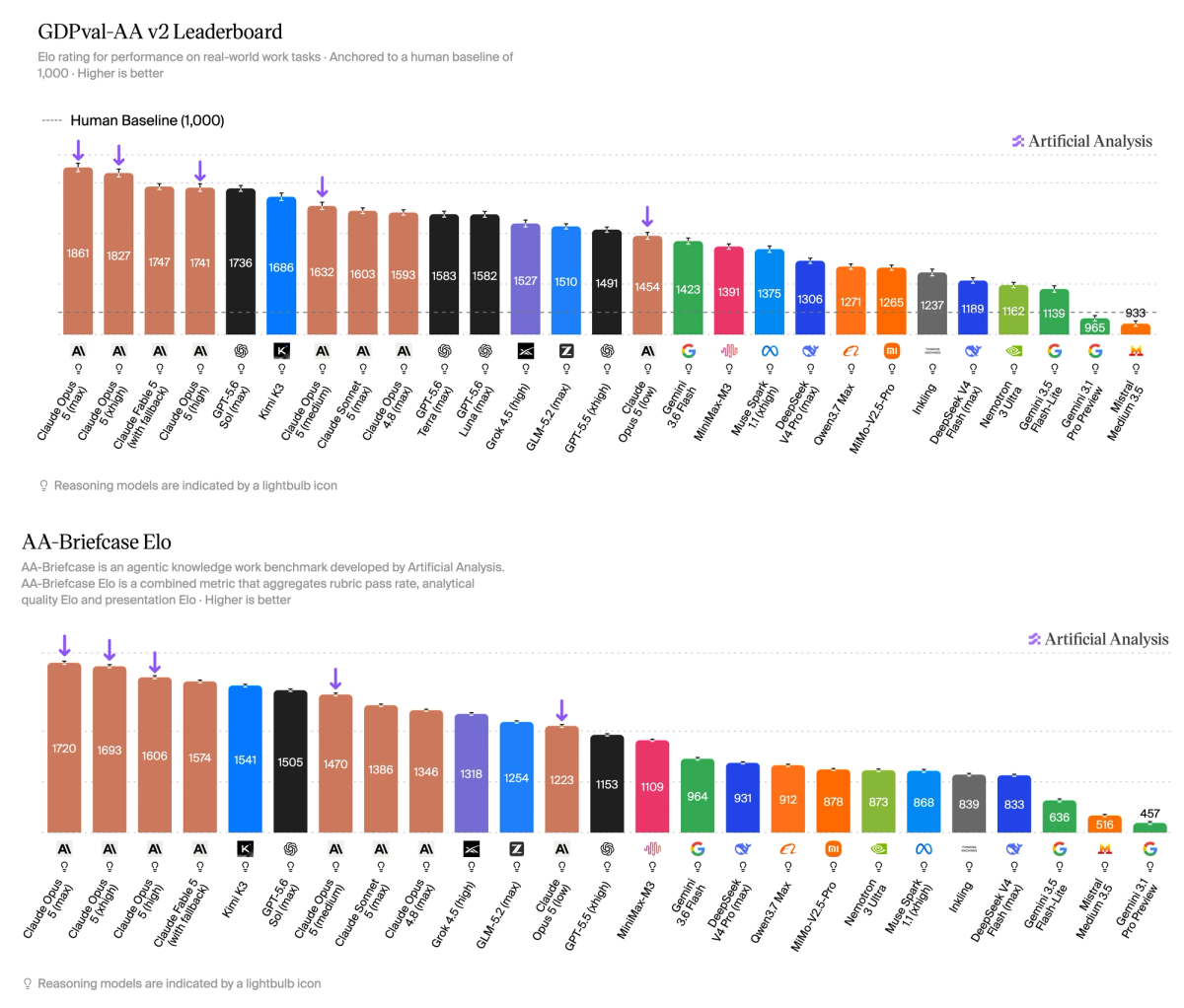
Figure 3. GDPval-AA v2 and AA-Briefcase Elo leaderboards. Source: Artificial Analysis. Error bars are confidence intervals; Elo is a relative pairwise rating, not percent correct.
GDPval-AA v2 evaluates professional work products such as documents, slides, spreadsheets, and diagrams across 44 occupations. Opus 5 takes the top two positions at 1861 Elo for max and 1827 for xhigh. Fable 5 scores 1747, Opus 5 high scores 1741, GPT-5.6 Sol scores about 1735, and Opus 4.8 scores 1593. Importantly, xhigh uses 25% fewer output tokens than max while still beating every comparison model in this leaderboard.
AA-Briefcase is an even longer-horizon test using complex projects, thousands of input files, and deliverables such as reports, presentations, and spreadsheets. Opus 5 scores 1720 at max, 1693 at xhigh, and 1606 at high, ahead of Fable 5 at 1574 and GPT-5.6 Sol around 1503-1505. Artificial Analysis attributes the gain mainly to rubric completion and analytical quality. Presentation Elo is 1628, about 40 points behind GPT-5.6 Sol at 1666, so Opus 5 is not the undisputed visual-finish leader.
The cost and time tradeoff matters. AA-Briefcase costs $17.79 per task at max, $14.26 at xhigh, and $10.41 at high, versus $22.30 for Fable 5. The top three Opus settings average 36.2, 34.3, and 25.7 minutes per task, respectively. This is strong evidence for difficult deliverables where a human might otherwise spend hours, but a poor fit for interactive interfaces with a ten-second patience budget.
Research and document recommendation
Use high for routine professional deliverables and measure completeness, citations, numerical correctness, formatting, and human edit time. Move to xhigh when the project contains many linked files or steps. Use max only when the extra Elo or rubric coverage matters more than a roughly 36-minute benchmark runtime. For presentation-heavy work, compare against GPT-5.6 Sol and retain a visual QA pass.
Business automation improves sharply, but remains far from autonomous reliability
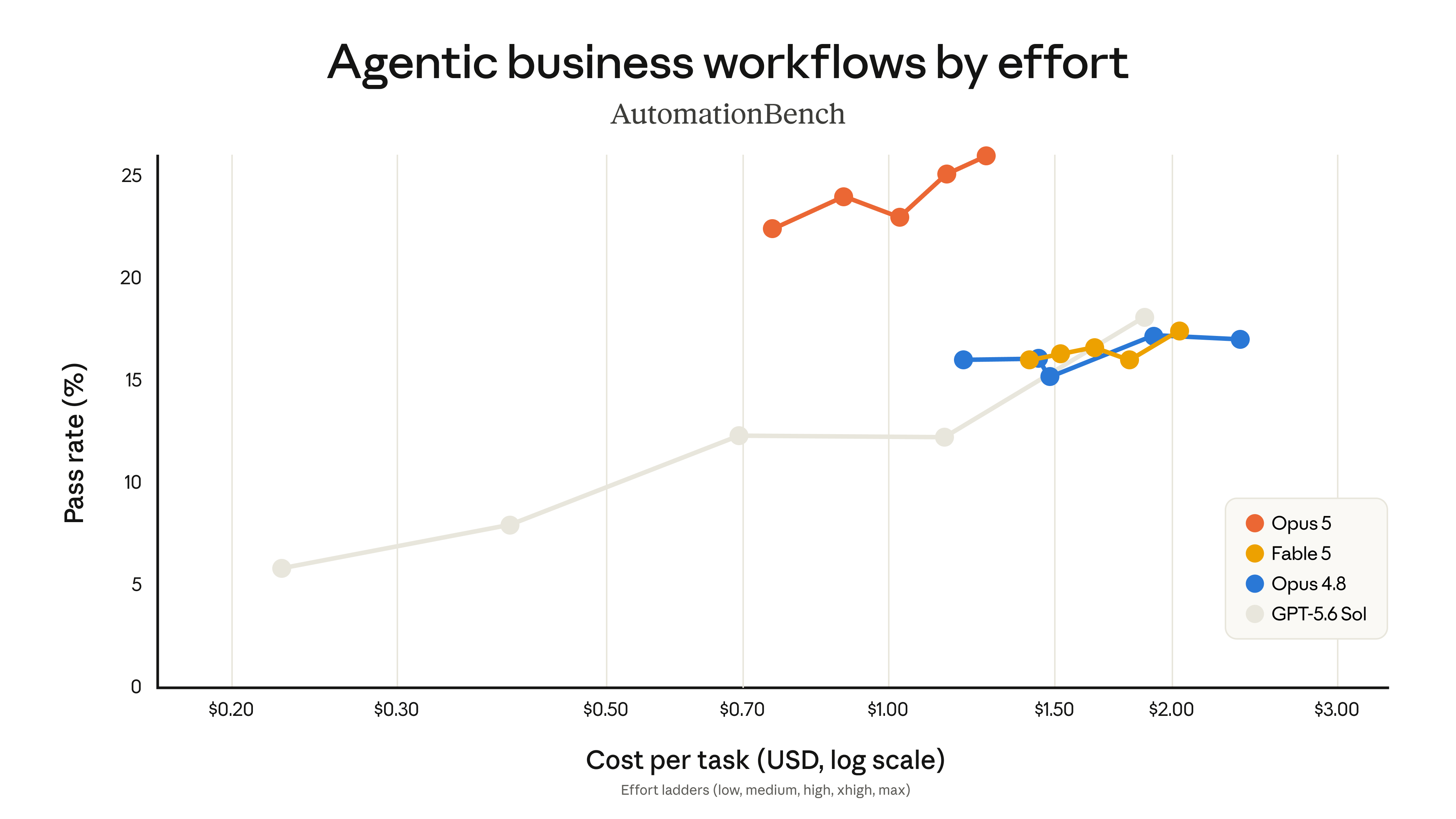
Figure 4. AutomationBench score versus cost by effort level. Source: Anthropic launch report; current exact leaderboard values are maintained by Zapier AutomationBench.
AutomationBench tests end-to-end work across simulated CRM, email, calendar, messaging, spreadsheets, and other systems. It uses deterministic assertions on final application state rather than judging the assistant's prose. Version 1.0.5 ranks Opus 5 max first at 26.2% and $1.27 per task, followed by xhigh at 25.1% and $1.15, medium at 23.6% and $0.89, high at 23.0% and $1.03, and low at 22.4% and $0.75. GPT-5.6 Sol max scores 18.1%, Fable 5 max 17.4%, and Opus 4.8 xhigh 17.2%.
This is a meaningful gain, but the correct operational reading is that even the best configuration fails almost three quarters of strict end-to-end tasks. Medium retains about 90% of the max score at roughly 70% of the cost. That makes it a strong trial setting for bounded sales, support, finance, or operations workflows with deterministic validation.
Do not let the agent send payments, delete records, publish content, or message customers solely because it says the task is complete. Use idempotency keys, allowlisted tools, preconditions, post-action state checks, approval gates, and logs that record model, effort, tokens, latency, tool calls, and final task status.
Computer use, vision, long context, and reasoning
Opus 5 scores 70.6 on OSWorld 2.0 in Anthropic's system card, ahead of Fable 5 at 66.1, GPT-5.6 Sol at 62.6, and Opus 4.8 at 55.7. This supports browser and desktop agents that must inspect state and iterate, particularly when paired with screenshots and verification tools. It does not guarantee reliable operation on an arbitrary website; OSWorld is a controlled benchmark, and application changes, pop-ups, authentication, accessibility trees, and network failures still dominate production behavior.
Vision gains are most convincing when vision is combined with tools. SWE-bench Multimodal rises from 38.4 on Opus 4.8 to 59.4 on Opus 5. Anthropic also reports gains in chart understanding, UI replication, computer-aided design, and frontend verification. The correct use is analysis and action from images, diagrams, PDFs, or screenshots. Opus 5 outputs text; use a separate image or video model when the product needs generated media.
On Humanity's Last Exam without tools, Opus 5 scores 56.3, almost tied with Fable 5 at 56.5. With tools, Opus 5 reaches 64.7 versus Fable's 63.9 and Opus 4.8's 57.9. On ARC-AGI-3, the ARC Prize Foundation verifies 30.16% at high, compared with 7.78% for GPT-5.6 Sol max and 1.52% for Opus 4.8 high. Only high was tested because of the short pre-release window, so there is no verified max result yet.
These results suggest strong novel-problem exploration, but ARC-AGI-3 is an interactive game benchmark, not a proxy for invoice accuracy, code merge rate, or customer-support quality. Use it as evidence of flexible problem solving, then evaluate the real workflow.
Price, speed, and the effort dial
For a standard workload of 1 million input tokens and 200,000 output tokens, Opus 5 costs:
- Standard: $5 + 0.2 × $25 = $10
- Batch: $2.50 + 0.2 × $12.50 = $5
- Fast mode: $10 + 0.2 × $50 = $20
The same standard workload costs $20 on Fable 5 and $11 on GPT-5.6 Sol at official list rates. Through August 31, 2026, Sonnet 5's introductory $2/$10 pricing makes it $4. Token price still does not equal task price: effort changes output length and tool loops, caching changes repeated input cost, and retries can make a cheap failure more expensive than a costly success.
Artificial Analysis estimates $2.03 per Intelligence Index task for Opus 5 max, below Fable 5 with fallback at $2.75 but above Opus 4.8 at $1.80 and Sonnet 5 at $1.53. It measured about 52.8 output tokens per second for Opus 5 max, ranking the model toward the slow end of its comparison group. The model generated 100 million output tokens across that evaluation, versus a 63 million median, so verbosity is part of its cost profile.
Use the effort dial as a routing policy:
| Effort | Best starting use | Main risk |
|---|---|---|
low | Simple subagents, triage, routine transformation | Missed steps on complex work |
medium | Bounded automation, minimal-diff coding, cost-controlled agents | Lower ceiling on deep reasoning |
high | Default for complex reasoning, coding, and agents | More latency and output than routine tasks need |
xhigh | Long-running coding, research, and multi-tool workflows | Large token and time increase |
max | Frontier problems where measured success is worth maximum compute | Overthinking, verbosity, latency, and scope expansion |
Effort is a behavioral signal, not a hard token budget. Lower settings can still think on difficult requests, and higher settings need a sufficiently large max_tokens. Because thinking is on by default, the output limit covers both thinking and visible response text.
Reliability, hallucination, and safety
A stronger model can be more accurate and still hallucinate more often when uncertain. Anthropic's closed-book AA-Omniscience analysis reports that Opus 5's accuracy is 11% higher than Opus 4.8, while its hallucination rate is 6% higher. The model appears more willing to answer rather than abstain. This test provides no web search or knowledge base, so the production response should be retrieval and verification, not a blanket rejection of the model.
For factual research, require citations tied to retrieved evidence, validate numbers with code, and separate sourced facts from model inference. For legal, medical, finance, or compliance use, add qualified human review and domain-specific tests. Anthropic's HealthBench results also show why verbosity matters: Opus 5 scores 67.1 raw but 57.8 after a length adjustment. A longer answer can add useful context, but it can also bury the recommendation and increase opportunities for error.
Anthropic describes Opus 5 as its most aligned recent model in an automated behavioral audit, with an overall misaligned-behavior score of 2.3, lower being better. The system card still reports rare attempts to work around safety classifiers or network restrictions, and no benchmark can remove the need for permissions, sandboxing, least privilege, and monitoring. For cybersecurity, Opus 5 approaches Mythos 5 at finding vulnerabilities but remains substantially behind it at exploitation; stronger guardrails block binary vulnerability scanning, penetration testing, and exploit generation.
Best model by application scenario
| Scenario | Recommended starting point | Why | What to compare |
|---|---|---|---|
| Large codebase bug fixing | Opus 5 high | Strong SWE-bench and root-cause profile | GPT-5.6 Sol for DeepSWE and terminal-heavy tasks |
| Minimal pull request | Opus 5 medium | FrontierCode peaks below max effort | Fable 5; enforce change scope |
| Long-running coding agent | Opus 5 xhigh | Strong Coding Agent Index and long-horizon behavior | GPT-5.6 Sol for speed and coding ties |
| Research report or spreadsheet | Opus 5 high or xhigh | Leads GDPval-AA and AA-Briefcase | GPT-5.6 Sol for presentation finish |
| Cross-app business automation | Opus 5 medium | Near-max AutomationBench score at lower cost | Deterministic checks and human approval |
| Browser or computer-use agent | Opus 5 high | Leading OSWorld 2.0 result | Real-site completion and recovery rate |
| High-volume support chat | Sonnet or a cheaper model | Opus latency and verbosity are unnecessary | Escalate only hard cases to Opus |
| Closed-book factual Q&A | Retrieval plus Opus 5 high | Strong reasoning, but hallucination risk remains | Citation accuracy and abstention rate |
| Visual UI analysis | Opus 5 high with tools | Large multimodal coding gains | Separate media-generation model for images/video |
| Cybersecurity | Opus 5 for defensive source review | Strong vulnerability discovery with safeguards | Mythos for approved specialized workflows |
API migration notes from Opus 4.8
Changing the model ID from claude-opus-4-8 to claude-opus-5 is only the first step. Opus 5 enables adaptive thinking by default, so existing requests may use more output tokens or reach a low max_tokens limit. Explicitly setting thinking to disabled is accepted only at high effort or below; combining disabled thinking with xhigh or max returns HTTP 400.
The model also tends to produce longer deliverables, narrate agent progress more often, delegate to subagents more readily, and verify its own work without being asked. Remove inherited prompts such as always run a final verification subagent if they cause duplicate work. Add concise-output, task-scope, and stop-condition instructions where appropriate.
Opus 5 lowers the minimum cacheable prompt from 1,024 to 512 tokens. It can also add or remove tools between conversation turns while preserving the prompt cache through a beta header. These features are valuable for agents with large tool catalogs, but beta behavior and provider compatibility should be tested before production migration.
Where LumeAPI fits today
As of July 25, 2026, LumeAPI's public catalog includes Claude Opus 4.8, Opus 4.7, Sonnet 4.6, and Fable 5, but not Claude Opus 5. Do not send the guessed model ID through LumeAPI or assume that the official $5/$25 rate receives the same discount as an older Claude model. Check the live catalog and Claude API hub before implementation.
Once a required model is listed and its endpoint behavior is verified, LumeAPI's product advantage is operational consolidation: one account and gateway can cover multiple LLM families and the same wallet can cover text, image, and video models. Catalog prices are advertised as up to 70% below official reference rates, but the reduction is model-specific and does not currently apply to an unlisted Opus 5 route. Per-call usage logs can then be used to compare model, token, cost, latency, and request outcome as part of a controlled routing experiment.
A safe adoption path is to keep a model allowlist, run the same representative task set across currently available Claude and GPT models, record cost per successful task, and add Opus 5 only after the catalog, exact model ID, price, features, and rollback route are verified.
Detailed pairwise comparisons
Use the broad review for the overall Opus 5 adoption decision, then open the comparison that matches the alternative you are actively considering:
- Opus 5 vs Fable 5 — official price premium, coding, professional work, and Fable safety fallback.
- Opus 5 vs GPT-5.6 Sol — coding agents, Responses API tools, presentation quality, and long-context pricing.
- Opus 5 vs Kimi K3 — task-loop economics and Kimi's announced open-weight path.
- Opus 5 vs Sonnet 5 — volume-tier routing, speed, tokenizer changes, and escalation economics.
- Opus 5 vs Grok 4.5 — coding-agent value, context tiers, factual controls, and ecosystem fit.
Final recommendation
Claude Opus 5 is a major Opus release because it shifts the useful frontier from raw benchmark intelligence toward complete work: code changes, research artifacts, computer operation, and cross-application workflows. Its strongest evidence is the combination of leading GDPval-AA and AA-Briefcase results, a large AutomationBench gain, strong OSWorld performance, and near-frontier coding scores at half Fable 5's list price.
Adopt it selectively, not universally. Begin at high, benchmark medium for bounded automation and minimal code changes, and use xhigh for long-horizon work. Treat max as a measured escalation rather than a badge. Keep retrieval and citations for factual work, deterministic state checks for automation, tests and scope limits for coding, and human approval for high-impact actions. The model is good enough to reduce supervision on some tasks; the current evidence does not support removing supervision from the workflow.
Sources and methodology
- Anthropic: Introducing Claude Opus 5 — release date, vendor benchmark charts, product positioning, and early-access examples.
- Anthropic: Claude Opus 5 System Card — benchmark configurations, capability table, safety, alignment, and hallucination evidence.
- Claude Platform models overview — model ID, context, output limit, modalities, cutoff, and default effort.
- Claude Opus 5 API changes — thinking defaults, effort ladder, cache minimum, tool changes, fast mode, and migration behavior.
- Anthropic pricing — standard, cache, batch, fast-mode, and long-context pricing.
- Artificial Analysis Opus 5 evaluation and AA-Briefcase analysis — independent composite, coding, professional-work, cost, speed, and effort results.
- ARC Prize verified Opus 5 results — ARC-AGI-1, ARC-AGI-2, and ARC-AGI-3 results and testing limits.
- Zapier AutomationBench — deterministic end-to-end business automation leaderboard and methodology.
- OpenAI GPT-5.6 Sol — comparison model specifications and official pricing.
- LumeAPI model catalog — dated availability and current gateway pricing check.
Benchmark values were cross-checked on July 25, 2026. Scores from different evaluations were not averaged, and vendor-reported, independent, and benchmark-owner evidence are labeled separately. No billable Opus 5 inference request was available for this report; real production selection still requires an application-specific evaluation.